

The short version
- What changed: business texts from standard 10-digit numbers run on A2P 10DLC, where your brand and campaign are verified before you send.
- Who it affects: any business that texts customers or leads from a local 10-digit number, including brokers, lenders, agencies and call centers.
- What to do: register your brand through your texting provider, then a campaign with a clear use case, real sample messages and the opt-in flow your website shows.
- When: before your first campaign, and again when your use case, business details or opt-in flow change.
A2P 10DLC is the channel for business texts sent from standard 10-digit phone numbers. To use it, your texting provider registers your brand (your legal business details) and each campaign (what you send, to whom, and how they opted in) with The Campaign Registry. Carriers review the campaign, and approved numbers can then send.
What is A2P 10DLC?
A2P means application-to-person: texts sent from a business system, not typed by one person to another. 10DLC means 10-digit long code, a standard local phone number. Put together, A2P 10DLC is business texting on local numbers.
The Campaign Registry (TCR) runs the central registry for this channel. TCR describes 10DLC as an A2P channel where brands and Campaign Service Providers are verified before they can send. Short codes and toll-free numbers have their own approval processes. This guide covers 10DLC only.
Who needs 10DLC registration?
Any business that sends A2P texts from 10-digit numbers: marketing, lead follow-up, appointment reminders, account alerts or customer care. That includes MCA brokers, lenders, agencies, call centers and lead-gen teams.
You do not register with TCR yourself. TCR says direct registration is not available for brands. Your texting provider, acting as a Campaign Service Provider (CSP), submits your brand and campaigns for you.
How does 10DLC registration work, step by step?
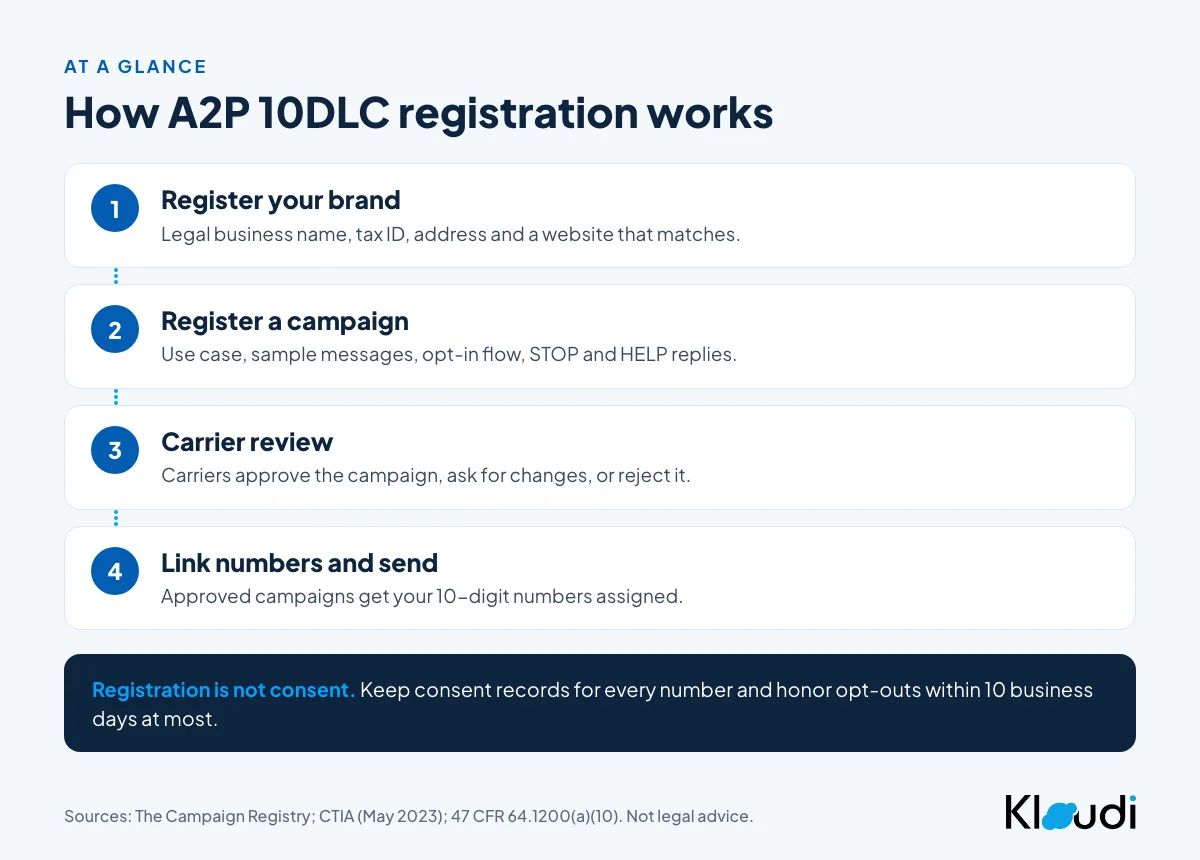
- Register your brand. Your legal business name exactly as it appears on your tax records, your tax ID (an EIN for most US businesses), business address, website, contact details and industry.
- Complete verification. The registry checks your business identity. Many providers also offer an optional extra vetting step. Carriers can use vetting results when they set your sending limits.
- Register a campaign. Choose the use case (for example marketing, account notifications or customer care), describe the program, add sample messages, explain how people opt in, and list your opt-in, STOP and HELP replies. Flag anything the campaign includes, such as links, phone numbers or lending content.
- Carrier review. Carriers review the campaign. They approve it, ask for changes, or reject it.
- Link your numbers and send. Once the campaign is approved, your provider assigns your 10-digit numbers to it.
Repeat step 3 for each new use case. A campaign registered for account alerts does not cover marketing texts.
What do reviewers check in a 10DLC campaign?
Reviewers compare what you registered with what they can see. In practice they look at five things:
- Your website. A live site with real content, your business name and ways to contact you. CTIA’s Messaging Principles and Best Practices (May 2023, section 5.3.2) say websites linked from messages should clearly identify the owner and include contact information, such as a postal address.
- Your privacy policy. CTIA (section 5.2.1) says senders should display a clear privacy policy that explains how they collect, use and share information, linked from the opt-in. Reviewers commonly also look for a line saying mobile numbers and SMS consent are not shared with third parties for marketing.
- Your call to action. CTIA (section 5.1.1) lists what a consumer should know before opting in: the program description, the number texts come from, who is texting, any fees, and terms such as how to opt out and how to reach support.
- Your sample messages. Each one should name your business, match the use case you picked, and include opt-out wording such as “Reply STOP to opt out.”
- Your list source. CTIA (section 5.1.4) says senders should not use opt-in lists that were rented, sold or shared.
The full website list is in our 10DLC website requirements checklist. To see how your site reads to a reviewer, run it through our free 10DLC compliance checker.
How much does 10DLC registration cost?
Two kinds of cost apply. The Campaign Registry and the carriers charge their own fees: one-time brand and vetting fees, recurring campaign fees, and per-message carrier fees. They set those amounts and change them from time to time, so check the current figures with your provider before you submit.
The second cost is the work: building or fixing the website, writing the campaign and sample messages, and handling review. Kloudi lists a $299 one-time fee for a compliant website plus 10DLC brand and campaign registration on our pricing page. Our 10DLC registration service explains what it covers.
Should you use 10DLC or a toll-free number?
Both work for business texting. 10DLC gives you local numbers and goes through TCR brand and campaign registration. Toll-free numbers go through a separate toll-free verification process instead. Either way, the consent, opt-out and record-keeping rules below still apply.
Why do 10DLC campaigns get rejected?
The usual reasons are fixable:
- Campaign details that are incomplete or vague.
- A website that does not match the business name you registered.
- Missing or unclear consent wording on the opt-in form.
- Sample messages that do not name the sender or include opt-out wording.
- Content that falls outside the use case, or that carriers restrict.
- Consent collected for someone else. CTIA (section 5.1.2.2) says an opt-in applies only to the sender and campaign it was given for, and is not transferable.
If a campaign was sent back, start with our guide to 10DLC campaign rejection, then fix the site before you resubmit.
Does 10DLC registration cover TCPA consent?
No. Registration is a carrier requirement. It does not replace the consent the Telephone Consumer Protection Act requires. For marketing texts sent with an autodialer, that is prior express written consent (47 CFR 64.1200(a)(2)), and every opt-out has to be honored within 10 business days (47 CFR 64.1200(a)(10)).
What stays on you as the sender:
- Consent records for every number: when, where, and the exact language the person agreed to. CTIA (section 5.1.2) lists the details worth keeping, including a timestamp, the opt-in method and the wording shown.
- Opt-out handling across every channel, logged to one suppression list.
- List sourcing. If you buy leads, keep the consent record for every number: where, when and the exact language.
- Scrubbing and quiet hours before each campaign.
Our TCPA compliance checklist for text messages covers each one.
How does Kloudi help with 10DLC registration?
Kloudi onboarding includes a compliant website and the preparation and submission of your 10DLC brand and campaign registration. We keep you updated through carrier review. Carriers make the final decision, so no provider can promise approval. What is included today is on our pricing page.
What to check with your counsel
- Does your opt-in wording cover every type of message you plan to send, including marketing?
- If you buy or share leads, does each consent name your business clearly?
- Do the states you text into add rules on consent, timing or disclosures?
- Does your privacy policy match how you actually use and share phone numbers?
Frequently asked questions
What is A2P 10DLC?
A2P 10DLC is business texting from standard 10-digit local numbers. Your brand and each campaign are registered with The Campaign Registry through your texting provider, and carriers review the campaign before your numbers can send.
Is 10DLC registration required?
For business texts sent from standard 10-digit numbers, yes. The 10DLC channel is built on verifying brands and campaigns before they send, and carriers filter or block A2P traffic that is not registered.
Can I register for 10DLC myself?
Not directly with the registry. The Campaign Registry says direct registration is not available for brands, so your texting provider submits your brand and campaigns as a Campaign Service Provider.
What is the difference between a 10DLC brand and a campaign?
The brand is your business: legal name, tax ID, address and website. A campaign is one messaging program: its use case, sample messages and opt-in flow. One brand can have several campaigns.
What do I need before I start 10DLC registration?
Your legal business name and tax ID, a live website that matches them, a privacy policy, SMS terms, an opt-in form with clear consent wording, and two or more sample messages that name your business and include opt-out wording.
This article is general information, not legal advice. Talk to your own counsel about how these rules apply to your business.
Sources
- The Campaign Registry, home page (10DLC, brands and Campaign Service Providers): https://www.campaignregistry.com/
- CTIA, Messaging Principles and Best Practices (May 2023), sections 5.1.1, 5.1.2, 5.1.2.2, 5.1.4, 5.2.1 and 5.3.2: https://api.ctia.org/wp-content/uploads/2023/05/230523-CTIA-Messaging-Principles-and-Best-Practices-FINAL.pdf
- 47 CFR 64.1200 (current text, eCFR): https://www.ecfr.gov/current/title-47/chapter-I/subchapter-B/part-64/subpart-L/section-64.1200