


The short version
- What changed: 47 CFR 64.1200(a)(2) requires prior express written consent for certain calls, and CTIA asks senders to state opt-out words in the message.
- Who it affects: Anyone texting leads or customers. Calls that include an advertisement or constitute telemarketing carry the written consent requirement.
- What to do: Put the business name, campaign and opt-out words next to the consent box, and keep a record of each opt-in.
- When: Now. Check your live forms before your next send.
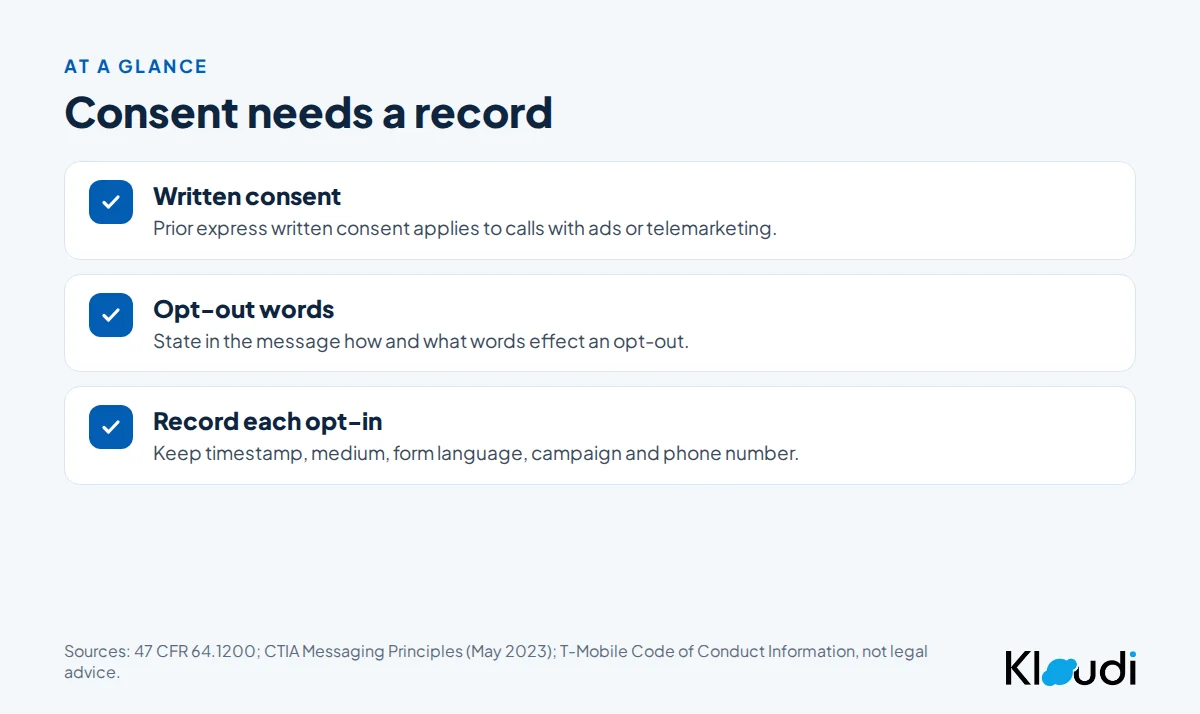
Good tcpa consent language names the business and the campaign, says what the lead agrees to, and states the words that stop the messages. 47 CFR 64.1200(a)(2) names prior express written consent for calls that include an advertisement or constitute telemarketing. CTIA asks senders to state opt-out words in the message. Keep a record of every opt-in.
What does the TCPA ask for in consent?
The rule in 47 CFR 64.1200(a)(1) covers calls made “using an automatic telephone dialing system or an artificial or prerecorded voice.” For calls to the lines in (a)(1)(i) through (iii), which include cellular numbers, 47 CFR 64.1200(a)(2) requires “prior express written consent” when the call includes an advertisement or constitutes telemarketing.
Whether a given text needs written consent depends on what it says. Check your own program with counsel.
Our read: a vague line at the bottom of a form is the weakest record you can keep.
What do carriers expect the opt-in message to say?
CTIA’s Messaging Principles (May 2023) say “Message Senders should state in the message how and what words effect an opt-out.” CTIA also says a consumer opt-in “should apply only to the campaign(s) and specific Message Sender for which it was intended or obtained.” Its opt-in section also refers to “clear and conspicuous language about any associated fees or charges and how those charges will be billed.”
CTIA also says senders should acknowledge opt-outs by “sending one final opt-out confirmation message per campaign.” No further messages should follow that confirmation.
T-Mobile’s Code of Conduct says that before a business sends promotional messages, the consumer “must agree in writing” to receive promotional texts.
CTIA is industry guidance and the T-Mobile Code is one carrier’s policy. Neither one is the TCPA. Our read: use the strictest version of these as your floor.
What does tcpa consent language look like on a form?
This is an illustrative template, not legal text. Have counsel review it before use.
“By entering my mobile number and checking this box, I agree to receive recurring marketing texts about [campaign name] from [business name]. Message and data rates may apply. Reply STOP to opt out.”
Our read: leave the box unchecked by default, and keep the consent text visible next to it when the lead submits the form.
What records should back each opt-in?
T-Mobile’s Code lists what a consent record can hold, including “The timestamp of consent acquisition” and “The capture of experience (e.g., language and action) used to secure consent.” It also lists the consent medium, such as a cell-submit form, a physical sign-up form or an SMS keyword, the campaign the opt-in covered, the phone number that granted consent, and the IP address used to grant consent.
CTIA says “Message Senders should retain and maintain all opt-in and opt-out requests in their records.” It also says “Message Senders should not use opt-in lists that have been rented, sold, or shared to send messages.”
Keep the exact form language shown at each opt-in, with the date it was live. If you buy leads, keep the consent record for every number.
What this means for operators who text
Form wording changes over time. The words a lead saw in March may not match what is on your form today, so keep dated copies of each version.
Before a campaign launches, Compliance Shield™ can be used to screen outbound lists: “National and state-level Do Not Call screening can be applied to outbound lists before deployment.” That is a list step, not a consent step. It does not write your consent language.
If you want a second look at your public pages, our 10DLC compliance checker lists the items it reads. For background on how one court read a text exchange, see our SMS consent ruling note. Neither is a source for the legal rule.
What to check with your counsel
- Does each of our texts include an advertisement or constitute telemarketing under 47 CFR 64.1200(a)(2)?
- Does our form meet the prior express written consent standard for each campaign?
- Do state rules add anything to the federal rule for our lead sources?
- Should our opt-out wording change for each campaign and sender?
Frequently asked questions
The rule does not say a checkbox is enough or not enough. It names prior express written consent for certain calls under 47 CFR 64.1200(a)(2). Ask counsel whether your form meets that standard.
CTIA says an opt-in “should apply only to the campaign(s) and specific Message Sender for which it was intended or obtained.” Keep consent tied to each campaign and sender.
CTIA says senders “should not use opt-in lists that have been rented, sold, or shared to send messages.” Create and vet your own opt-in lists. This is information, not legal advice.
Sources
- 47 CFR 64.1200
- CTIA Messaging Principles and Best Practices (May 2023)
- T-Mobile Code of Conduct, Version 2.2 (November 2020)
This article is general information, not legal advice. Talk to your own counsel about how these rules apply to your business.