

The short version
- What changed: in September 2026, two Colorado federal courts said a text is not a “telephone call” for TCPA do-not-call lawsuits and threw out text-only suits. A California federal court said the opposite.
- Who it affects: anyone who sends marketing texts. The FCC rule that applies the Do Not Call Registry to texts, 47 CFR 64.1200(e), did not change.
- What to do: keep scrubbing marketing texts against the registry and your internal list, keep quiet hours, and keep your consent records.
- When: now. The Tenth Circuit has not ruled, and the Seventh and Ninth Circuits point in different directions.
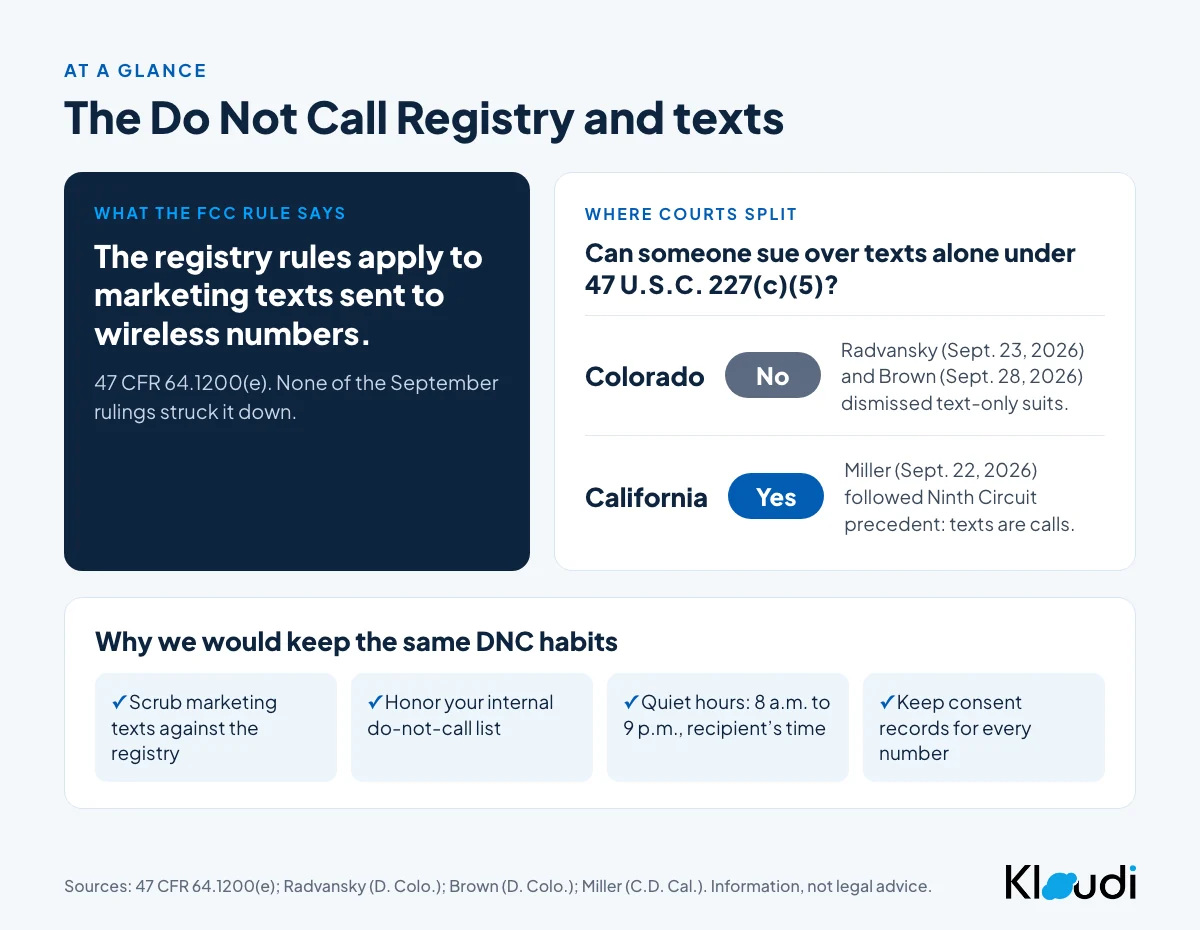
Does the Do Not Call Registry apply to text messages? Under the FCC’s rules, yes. 47 CFR 64.1200(e) applies the national registry rules to telephone solicitations sent as text messages to wireless numbers. Courts now disagree on something narrower: whether a person can sue over texts alone under the TCPA’s do-not-call private right of action.
Two Colorado federal courts said no in September 2026, under 47 U.S.C. 227(c)(5). California federal courts, bound by Ninth Circuit precedent, say yes. Here is what they held and why I would not change your DNC practices.
What did the Colorado courts decide?
Radvansky v. 1st Class Medical, No. 1:25-cv-03796-PAB-STV (D. Colo. Sept. 23, 2026): five marketing texts to a number on the registry since 2015. Judge Philip A. Brimmer dismissed the 227(c)(5) claim with prejudice “because plaintiff’s claim is based entirely on receiving unsolicited text messages, not telephone calls.”
Brown v. Hursh Group, LLC, No. 1:26-cv-00185-NRN (D. Colo. Sept. 28, 2026): marketing texts to a number on the registry. Magistrate Judge N. Reid Neureiter followed Radvansky and dismissed with prejudice.
Both note that the Tenth Circuit, which covers Colorado, has not ruled.
Why did those courts say a text is not a call?
Both followed Steidinger v. Blackstone Medical Services, No. 25-2398, 182 F.4th 532 (7th Cir. July 14, 2026): “texts are not calls, so § 227(c)(5) does not authorize the plaintiff’s suit.” The reasoning:
- Original meaning. When the TCPA passed, a telephone was “an instrument for reproducing sounds at a distance.” Texts do not reproduce sound.
- Different words. A “telephone solicitation” is “the initiation of a telephone call or message,” but 227(c)(5) covers only “more than one telephone call.”
- The FCC does not decide it. After McLaughlin Chiropractic Associates v. McKesson Corp., 606 U.S. 146 (2025), district courts are not bound by the FCC’s reading of the statute.
Brown also cites decisions from the Western District of Missouri and the Northern District of Alabama reaching the same result.
What are California courts saying?
Miller v. S. Brown & Associates, Inc., No. 2:26-cv-01480-MWC-SSC (C.D. Cal. Sept. 22, 2026): Judge Michelle Williams Court refused to dismiss, writing that “applying Steidinger would necessarily require this Court to reject Ninth Circuit precedent.” Citing Howard v. Republican National Committee, 164 F.4th 1119 (9th Cir. 2026), and Satterfield v. Simon & Schuster, Inc., 569 F.3d 946 (9th Cir. 2009), she held that “[t]ext messages constitute a call under § 227(c).”
Dilanyan v. Hugo Boss Fashions, Inc., No. 2:25-cv-05093-JLS-BFM (C.D. Cal. Dec. 3, 2025), a quiet-hours case under 47 CFR 64.1200(c)(1): Judge Josephine L. Staton held that Satterfield’s statement that a text is a call “within the meaning of the TCPA” appears broad enough to control. The Ninth Circuit denied permission to appeal on January 27, 2026 (No. 25-7951).
Does the Do Not Call Registry still apply to text messages after the split?
Yes. The split means a 227(c)(5) suit over texts alone can be dismissed early in some federal courts, so where a case is filed matters. It does not mean:
- The FCC’s rules changed. 47 CFR 64.1200(e) still covers “telephone solicitations or telemarketing calls or text messages to wireless telephone numbers.” None of these decisions struck it down.
- The law is settled. District court rulings do not bind other judges, and the circuits point in different directions.
- Other claims went away. The Ninth Circuit has treated texts as calls under the autodialer section, 227(b). State attorneys general can sue under 227(g), and state telemarketing laws use their own wording.
Do you need to scrub your text list against the Do Not Call Registry?
Yes, for marketing texts. Your leads live in many states, and you do not pick where you get sued. What holds up in Denver may not hold up in Los Angeles. Keep doing all of it:
- Scrub marketing texts against the National Do Not Call Registry.
- Honor your internal do-not-call list.
- Respect quiet hours: no telephone solicitations before 8 a.m. or after 9 p.m. at the recipient’s location.
- Keep consent records showing when and how each person agreed to your texts.
If you text through Kloudi, our DNC scrub and known litigator screening can be applied to your list before a campaign goes out. It is a screening step, not a substitute for your own consent and opt-out records. Opt-outs are the other half; see our guide to revocation of consent under the TCPA.
What to check with your counsel
- Where do most of your recipients live, and how do courts there treat texts?
- Does your DNC scrubbing cover purchased leads?
- Are your quiet hours based on the recipient’s location or your own?
- Do state telemarketing laws that apply to you cover texts expressly?
Frequently asked questions
Does the Do Not Call list apply to text messages?
Yes, under the FCC’s rules. 47 CFR 64.1200(e) applies the do-not-call rules to marketing texts sent to wireless numbers. The court split is only about who can sue under 47 U.S.C. 227(c)(5).
Is there a separate do not call or text list?
Not under federal rules. One National Do Not Call Registry covers calls and marketing texts to wireless numbers. State laws use their own wording, so ask your counsel.
Do I need to scrub my SMS list against the Do Not Call Registry before texting?
For marketing texts, yes. Scrub against the registry, honor your internal list, and keep consent records. Courts inside the Ninth Circuit still treat texts as calls.
Can someone sue over marketing texts to a number on the Do Not Call Registry?
It depends on the court. Radvansky and Brown in Colorado dismissed text-only claims under 227(c)(5). Miller in California let one proceed. The Tenth Circuit has not ruled.
This article is general information, not legal advice. Talk to your own counsel about how these rules apply to your business.
Sources
- Radvansky v. 1st Class Medical, No. 1:25-cv-03796-PAB-STV, ECF No. 49 (D. Colo. Sept. 23, 2026), order: https://www.govinfo.gov/app/details/USCOURTS-cod-1_25-cv-03796 (docket: https://www.courtlistener.com/docket/71952009/radvansky-v-1st-class-medical/)
- Brown v. Hursh Group, LLC, No. 1:26-cv-00185-NRN, ECF No. 22 (D. Colo. Sept. 28, 2026), order: https://www.govinfo.gov/app/details/USCOURTS-cod-1_26-cv-00185 (docket: https://www.courtlistener.com/docket/72151747/brown-v-hursh-group-llc/)
- Steidinger v. Blackstone Medical Services, No. 25-2398, 182 F.4th 532 (7th Cir. July 14, 2026): https://www.govinfo.gov/app/details/USCOURTS-ca7-25-02398
- Miller v. S. Brown & Associates, Inc., No. 2:26-cv-01480-MWC-SSC, ECF No. 61 (C.D. Cal. Sept. 22, 2026): https://storage.courtlistener.com/recap/gov.uscourts.cacd.1006494/gov.uscourts.cacd.1006494.61.0.pdf
- Dilanyan v. Hugo Boss Fashions, Inc., No. 2:25-cv-05093-JLS-BFM, ECF No. 35 (C.D. Cal. Dec. 3, 2025): https://storage.courtlistener.com/recap/gov.uscourts.cacd.973340/gov.uscourts.cacd.973340.35.0.pdf; Ninth Circuit order denying permission to appeal, No. 25-7951 (Jan. 27, 2026), filed as ECF No. 36-1: https://storage.courtlistener.com/recap/gov.uscourts.cacd.973340/gov.uscourts.cacd.973340.36.1.pdf
- 47 U.S.C. 227: https://www.law.cornell.edu/uscode/text/47/227
- 47 CFR 64.1200 (eCFR): https://www.ecfr.gov/current/title-47/chapter-I/subchapter-B/part-64/subpart-L/section-64.1200