

The short version
- What changed: on Sept. 30, 2026 the FCC adopted a new opt-out order (FCC 26-67). Once it takes effect, you can name one opt-out method, like reply STOP, if you disclose it in every message.
- Who it affects: anyone who texts or calls with consent, including brokers, ISOs and lenders. For marketing messages, one opt-out still stops all of your marketing.
- What to do now: treat any clear request to stop as an opt-out, from any channel, and honor it within 10 business days.
- When: the new rules start 30 days after the order is published in the Federal Register. It had not been published as of Oct. 11, 2026.
Revocation of consent under the TCPA happens when a consumer tells you, by any reasonable method, that they want your calls or texts to stop. A STOP reply, an email or a request on a call can all count. Under the FCC’s rule, 47 CFR 64.1200(a)(10), you must honor it within a reasonable time, no more than ten business days.
We at Kloudi work with brokers, lenders and lead-gen teams who text every day. Here is what changed and what I would do. For the consent side, see the latest TCPA consent ruling.
What did the FCC adopt in 2024 on revocation of consent under the TCPA?
The FCC’s February 2024 order (FCC 24-24, CG Docket No. 02-278, 39 FCC Rcd 1988; 89 FR 15756, March 5, 2024) put these rules in 47 CFR 64.1200(a)(10) through (a)(12):
- A consumer may revoke “by using any reasonable method to clearly express a desire not to receive further calls or text messages.”
- Some methods always count: a key-press or voice opt-out, an opt-out website or number the caller designates, and a reply of “stop,” “quit,” “end,” “revoke,” “opt out,” “cancel,” or “unsubscribe.” Other words count if a reasonable person would read them as a revocation.
- A voicemail or email meant to reach you creates a rebuttable presumption of revocation.
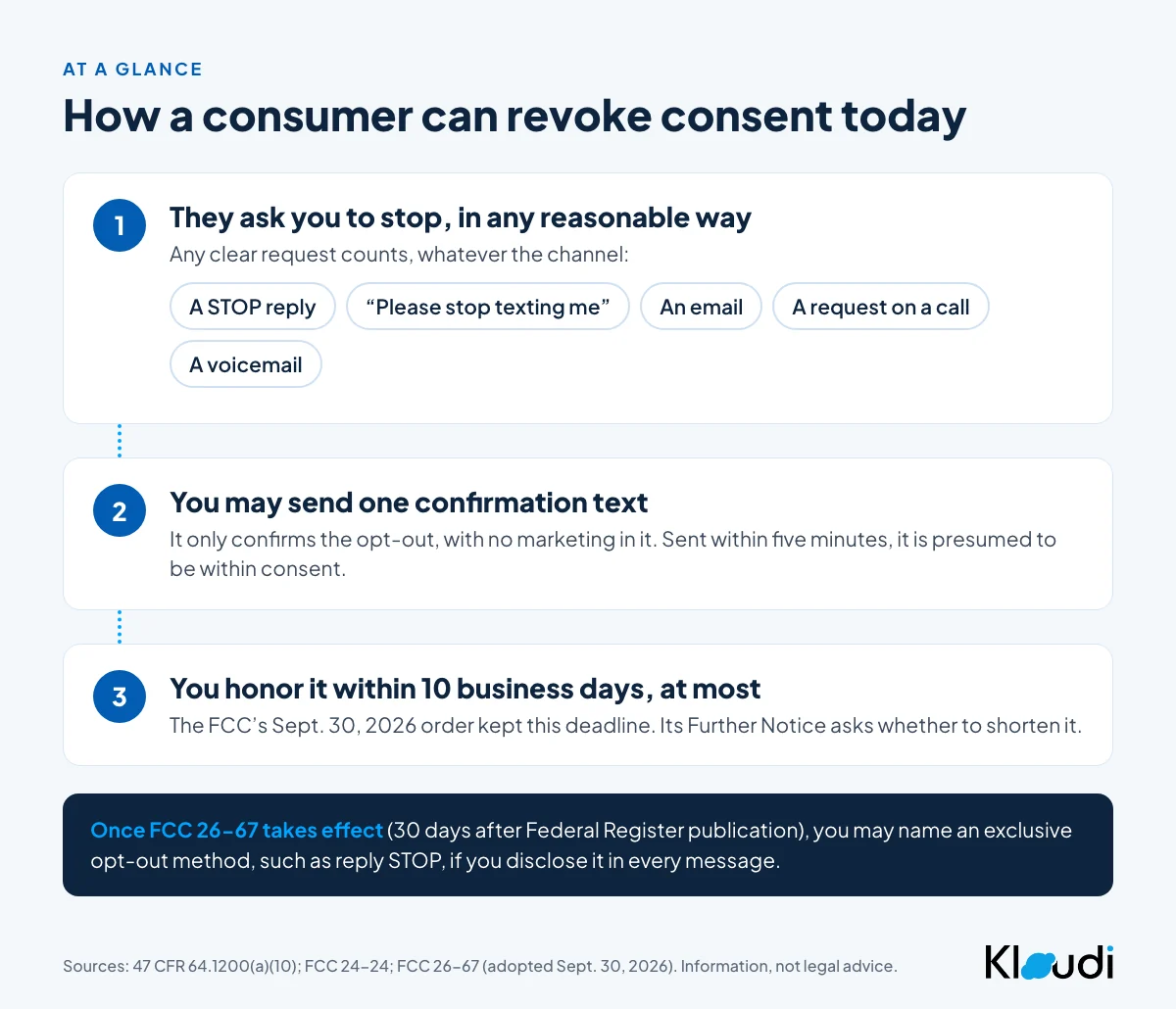
- One confirmation text with no marketing is allowed, and is presumed within consent if sent within five minutes.
- Honor revocations within a reasonable time, no more than ten business days.
The rule also says callers “may not designate an exclusive means to request revocation of consent.”
When did the 2024 rules take effect?
April 11, 2025 (89 FR 82518, October 11, 2024). The “revoke all” piece, which would make an opt-out from one type of informational message cover a caller’s unrelated robocalls and robotexts, was pushed to January 31, 2027 (FCC Consumer and Governmental Affairs Bureau, Order, DA 26-12, January 6, 2026).
What did the FCC change about consent revocation and opt-outs on September 30, 2026?
It adopted FCC 26-67, a Report and Order and Further Notice of Proposed Rulemaking (CG Docket No. 02-278, released October 1, 2026). The revised rules in Appendix A do four things:
- Exclusive opt-out methods. You may name one or more of three methods as the only way to revoke: a key-press or voice opt-out, a reply with one of the seven standard words, or a website or phone number you designate. It must be clearly and conspicuously disclosed on the call or in the text. Name none, and revocations made “by any reasonable means” still count.
- Shorter text disclosures. If reply text is your method, “Reply STOP to opt out” in each message works. You must still honor all seven words.
- Category limits, informational messages only. An opt-out from an informational message can apply only to that category. An opt-out from a marketing message still revokes consent to all future marketing calls and texts from that caller.
- Fraud alerts. Financial institutions may send exempt fraud and security alerts to wireless numbers from a “reliable source,” as the rule defines it.
The ten-business-day deadline did not change. The Further Notice asks whether to shorten it (a joint industry and consumer group letter suggested seven business days), plus questions on two-way texting, a one-step “revoke all” option and affiliates.
When does the 2026 order take effect?
Thirty days after Federal Register publication, on a date the FCC will announce in a Public Notice. It then replaces the January 31, 2027 “revoke all” date. It had not been published when we checked on October 7, 2026, so for now any reasonable method counts and you cannot name an exclusive one.
How can a consumer revoke TCPA consent right now?
Any clear request to stop, through any channel: a STOP reply, “please stop texting me,” an email, a request on a call, or a voicemail.
What are the TCPA text message opt-out requirements for brokers and lenders?
Most broker and lender outreach is marketing, so the new category limit won’t help much. What I would do:
- Map every inbound channel. Texting platform, dialer, CRM, shared inboxes, web forms and voicemail all need a path to your suppression list.
- Use one suppression list. An opt-out caught in one tool stops sends from every tool and from anyone texting for you. Aim for well under ten business days.
- Send unclear replies to a person. Keyword matching alone is not enough under “any reasonable method.”
- Keep the confirmation text clean. One message, sent fast, no offer.
- Decide whether to name a method once the new rule is in effect. If you do, disclose it in every message and make sure it works.
- Keep records of each consent and each revocation: when, how, and when you processed it.
Our SMS marketing compliance guide covers the rest of the texting rules, and our piece on whether the Do Not Call Registry applies to text messages covers the registry side.
What to check with your counsel
- Is any of what you send informational, or is it all telemarketing?
- Should you name an exclusive opt-out method once FCC 26-67 takes effect, and with what disclosure?
- How fast do opt-outs from affiliates, lead sources and other tools reach your suppression list?
- Do any state laws that apply to you set shorter deadlines?
Frequently asked questions
What is revocation of consent under the TCPA?
A consumer taking back permission to receive calls or texts that need consent, “by using any reasonable method to clearly express a desire not to receive further calls or text messages” (47 CFR 64.1200(a)(10)).
How long do I have to honor a TCPA opt-out?
A reasonable time, no more than ten business days. The September 30, 2026 order kept that deadline; its Further Notice asks whether to shorten it.
What did the FCC change recently about consent revocation and opt-outs for text messages?
In FCC 26-67 (September 30, 2026), senders may name an exclusive opt-out method if they disclose it clearly, “Reply STOP to opt out” can meet the text disclosure, and an informational opt-out can be limited to that category. It takes effect 30 days after Federal Register publication.
Does a verbal cease and desist revoke TCPA consent?
Any reasonable method that clearly expresses a desire to stop counts, not only written requests. Treat a clear spoken request as a revocation and log it the same day.
What are the TCPA text message opt-out requirements in 2026?
Honor any reasonable opt-out, including the seven standard reply words, within ten business days, and send at most one confirmation text with no marketing. Once FCC 26-67 takes effect, you may name an exclusive method if you disclose it in every message.
This article is general information, not legal advice. Talk to your own counsel about how these rules apply to your business.
Sources
- FCC, Report and Order and Further Notice of Proposed Rulemaking, FCC 26-67, CG Docket No. 02-278 (adopted Sept. 30, 2026; released Oct. 1, 2026): https://docs.fcc.gov/public/attachments/FCC-26-67A1.pdf
- FCC, Report and Order and Further Notice of Proposed Rulemaking, FCC 24-24, CG Docket No. 02-278, 39 FCC Rcd 1988 (adopted Feb. 15, 2024; released Feb. 16, 2024): https://docs.fcc.gov/public/attachments/FCC-24-24A1.pdf
- Federal Register, “Strengthening the Ability of Consumers To Stop Robocalls,” 89 FR 15756 (Mar. 5, 2024): https://www.federalregister.gov/documents/2024/03/05/2024-04587/strengthening-the-ability-of-consumers-to-stop-robocalls
- Federal Register, effective date announcement, 89 FR 82518 (Oct. 11, 2024): https://www.federalregister.gov/documents/2024/10/11/2024-23605/strengthening-the-ability-of-consumers-to-stop-robocalls
- FCC Consumer and Governmental Affairs Bureau, Order, DA 26-12 (Jan. 6, 2026): https://docs.fcc.gov/public/attachments/DA-26-12A1.pdf
- 47 CFR 64.1200 (current text, eCFR): https://www.ecfr.gov/current/title-47/chapter-I/subchapter-B/part-64/subpart-L/section-64.1200