

The short version
- What happened: in Nickson v. TrueAccord (D. Md. Oct. 5, 2026), a TCPA autodialer claim over texts lost. The plaintiff had an allegation; the sender had evidence of how its texts were sent.
- Who it affects: anyone who texts. The do-not-call claim failed because the texts were about debt collection, so that part does not help anyone sending offers.
- What to do: keep consent records, an opt-out log with dates, where every number came from, and a record of each DNC scrub.
- When: now, before a demand letter arrives. These records are cheap to keep and expensive to rebuild later.
Two federal claims can turn text messages into TCPA violations: an autodialer claim under 47 U.S.C. 227(b), for texts sent with an automatic telephone dialing system without consent, and a do-not-call claim under 227(c), for telephone solicitations to numbers on the registry. A Maryland case from October 2026 shows both being decided on the facts.
In Nickson v. TrueAccord Corp., the plaintiff offered only an allegation that an autodialer was used. The debt collector put evidence in the record of how its texts were actually sent and won. My read: the facts that matter most are in your own records.
What counts as a TCPA violation for text messages?
The two federal claims raised in Nickson:
- Autodialer, 47 U.S.C. 227(b): texts sent with an automatic telephone dialing system (ATDS) without the required consent.
- Do-not-call, 47 U.S.C. 227(c): telephone solicitations to a number on the national do-not-call registry.
A private plaintiff can recover $500 per violation under 227(b)(3), or up to $500 under 227(c)(5), and a court may raise either award to as much as three times that for willful or knowing violations. Whether texts count as calls for 227(c)(5) is now disputed; see whether the Do Not Call Registry applies to text messages.
What happened in Nickson v. TrueAccord?
Nickson v. TrueAccord Corp., No. 8:25-cv-03686-DKC (D. Md.), memorandum opinion by Judge Deborah K. Chasanow, October 5, 2026. The plaintiff, who represented himself, had revoked consent with an original creditor in 2023. From August 25, 2024, he got texts about the same debt from TrueAccord, a debt collector. He sued under 227(b) and 227(c). TrueAccord won both.
Why did the TCPA autodialer claim over text messages fail?
Under Facebook, Inc. v. Duguid, 592 U.S. 395 (2021), an autodialer must be able “either to store a telephone number using a random or sequential generator or to produce a telephone number using a random or sequential number generator.” So the question was factual: how were these texts sent?
- The plaintiff: the complaint “contains only a conclusory assertion that TrueAccord used an ATDS.”
- TrueAccord: filed evidence, affirmed under oath, that its technology does not “create, derive or independently store telephone numbers” and “does not permit the sending of messages using random number generation or sequential number generation functionality.”
The court denied the plaintiff’s motion to compel more discovery, found “no genuine dispute” that the technology was not an ATDS, and granted summary judgment. The sender could show how its messages went out; the plaintiff could not show otherwise.
Did the revoked consent matter?
Not for this claim: “unless Plaintiff can establish that TrueAccord used an ATDS, the consent issue does not affect the outcome of this case.” That is narrow. Consent still matters for prerecorded or artificial voice messages, for marketing under the FCC’s rules, and under state laws. See our guide to revocation of consent under the TCPA.
Why did the do-not-call claim fail?
It was dismissed because a 227(c) claim like this needs telephone solicitations, which 47 U.S.C. 227(a)(4) defines as calls or messages “for the purpose of encouraging the purchase or rental of, or investment in, property, goods, or services.” Debt collection messages do not meet that definition.
How can brokers, lenders and lead-gen teams defend against TCPA text violation claims?
Build habits now that put the facts on your side later. The facts a plaintiff will test are mostly about your own operation:
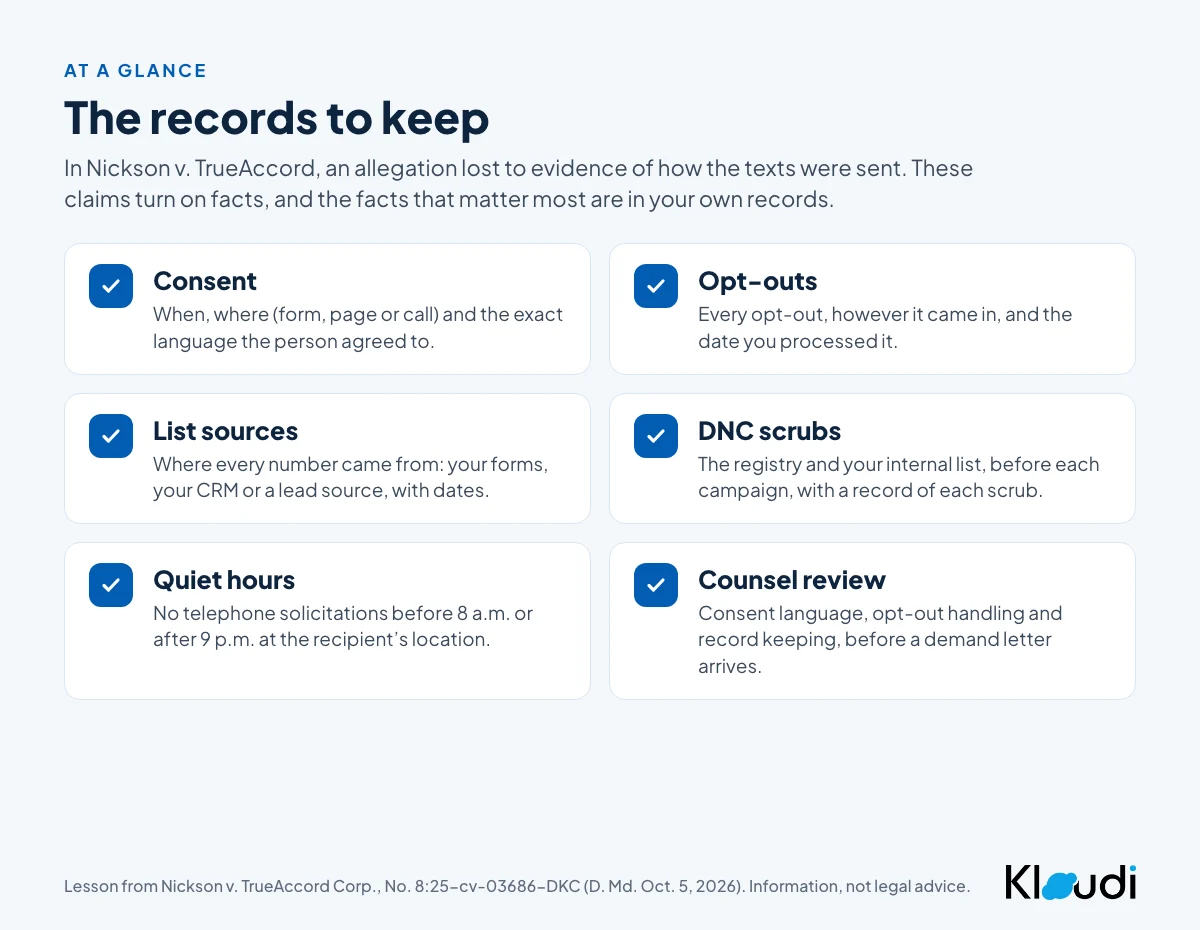
- Consent records. For every number: when, where (which form, page or call), and the exact language agreed to. Keep a copy of the form or script as it read that day.
- An opt-out log. Every opt-out, however it came in, and the date you processed it.
- List sources. Where every number came from (your forms, your CRM or a lead source), with dates. If you buy leads, keep what each source told you about how consent was collected.
- DNC and litigator scrubbing before each campaign. Scrub marketing texts against the National Do Not Call Registry and your internal list, and log each scrub. If you text through Kloudi, our DNC scrub and known litigator screening can be applied to your list before a campaign goes out. It is a screening step, not a substitute for your own consent and opt-out records.
- Quiet hours. No telephone solicitations before 8 a.m. or after 9 p.m. at the recipient’s location.
- Counsel review of your consent language, opt-out handling and record keeping, before a demand letter arrives.
Two limits. The do-not-call win was about debt collection; offers from brokers, ISOs and lead-gen teams are telephone solicitations, so the registry and quiet-hours rules apply. And if an autodialer question goes against you, consent is what a court looks at next.
This is one district court ruling, against a self-represented plaintiff, on its own facts. Other courts may weigh similar evidence differently.
What to check with your counsel
- If a demand letter arrived tomorrow, could you show when and how each number opted in?
- Do you keep each version of your consent language with the dates it was used?
- Which of your messages are telephone solicitations?
- Do state laws that apply to you define an autodialer more broadly?
Frequently asked questions
What are TCPA violations for text messages?
Two federal claims can apply: autodialer claims under 47 U.S.C. 227(b), for texts sent with an ATDS without consent, and do-not-call claims under 227(c), for telephone solicitations to numbers on the registry.
When is texting equipment an autodialer under the TCPA?
Under Facebook, Inc. v. Duguid, only if it can store or produce numbers using a random or sequential number generator. In Nickson, the evidence showed the technology could not.
How much can a TCPA text message violation cost?
$500 per violation under 227(b)(3) (or actual loss if greater), up to $500 under 227(c)(5), and up to three times that for willful or knowing violations.
What records should a texting business keep for TCPA claims?
For every number: when, where and how consent was given, where the number came from, each opt-out and when you processed it, and when it was scrubbed against the registry and your internal list.
This article is general information, not legal advice. Talk to your own counsel about how these rules apply to your business.
Sources
- Nickson v. TrueAccord Corp., No. 8:25-cv-03686-DKC, ECF No. 33, Memorandum Opinion (D. Md. Oct. 5, 2026): https://storage.courtlistener.com/recap/gov.uscourts.mdd.594319/gov.uscourts.mdd.594319.33.0.pdf (docket: https://www.courtlistener.com/docket/71914997/nickson-v-trueaccord-corp/)
- Facebook, Inc. v. Duguid, 592 U.S. 395 (2021): https://www.supremecourt.gov/opinions/20pdf/19-511_p86b.pdf
- 47 U.S.C. 227: https://www.law.cornell.edu/uscode/text/47/227
- Also covered by AccountsRecovery.net (Oct. 7, 2026).