

The short version
- What changed: The FCC’s TCPA rule names the words that revoke consent when sent as a reply to a text.
- Who it affects: Senders of texts covered by 47 CFR 64.1200(a)(1) through (3) and (c)(2). Check with counsel whether your messages fall under them.
- What to do: Stop messaging after a stop-type reply, log it, and process it within ten business days.
- When: Now. The ten business day limit is in the current rule text.
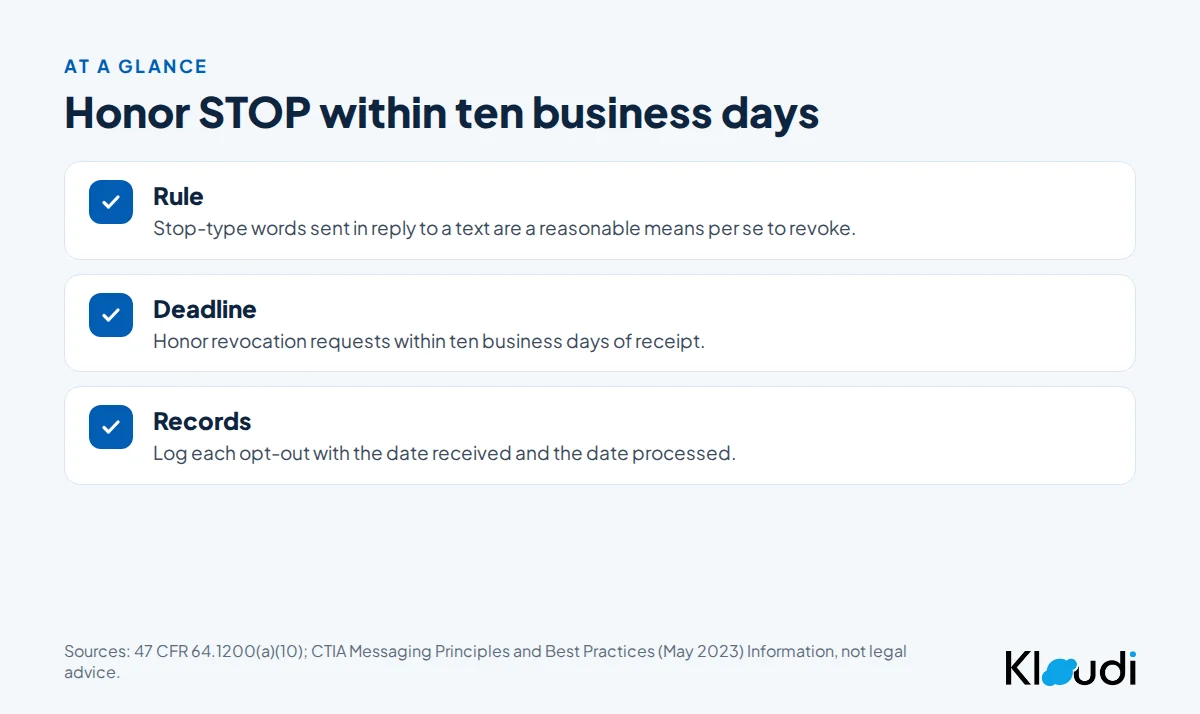
Treat a reply of STOP, QUIT, END, REVOKE, OPT OUT, CANCEL or UNSUBSCRIBE as a revocation. Under 47 CFR 64.1200(a)(10), those words sent in reply to a text are a reasonable means per se to revoke consent, and the request must be honored within ten business days. Handle sms stop and help keywords with a logged, dated process.
What does the rule say about STOP?
The rule is direct. It says revocation by “using the words “stop,” “quit,” “end,” “revoke,” “opt out,” “cancel,” or “unsubscribe” sent in reply to an incoming text message” constitutes a reasonable means per se to revoke consent. Once a called party uses one of those methods, the rule says “that consent is considered definitively revoked and the caller may not send additional robocalls and robotexts.”
That means your system has to catch these words in every inbound reply, not only in the replies a person happens to read. Our read: a keyword list that only works on one number or one campaign is a gap waiting to show up in a complaint.
Where does HELP fit?
HELP is not on the list in 47 CFR 64.1200(a)(10). The rule’s list covers stop-type words. So a HELP reply is not, by the text of that list, a revocation on its own.
The rule does say that other words can still count. If a reply uses words other than the listed ones, “the caller must treat that reply text as a valid revocation request if a reasonable person would understand those words to have conveyed a request to revoke consent.” Our read: answer HELP with a real support contact, and read every reply for stop intent, not just the keyword match.
How fast must a STOP be honored?
The rule sets an outer limit. Requests “must be honored within a reasonable time not to exceed ten business days from receipt of such request.” That is a ceiling, not a target. Our read: process opt-outs the same day your system receives them, and keep the timing in your records.
Can a sender limit how people opt out?
No. The rule says callers “may not designate an exclusive means to request revocation of consent.” If someone asks to stop by replying, by calling, or by using a web form, the request still counts. Do not build a process that only accepts one channel.
The CTIA Messaging Principles, which describe industry expectations, make the same point from the messaging side. Non-consumer senders should “Ensure that Consumers have the ability to revoke consent.”
What should a sender log?
Keep a record for every opt-out. Log the number, the exact reply text, the date and time received, and the date and time you stopped sending. Keep a record of where every number on your list came from, too. If a demand letter arrived tomorrow, could you show when and how each number opted in and when it opted out?
Consent gaps are a common reason campaigns get sent back. As our 10DLC campaign rejection guide puts it, “Rejection is a result of incomplete campaign information & unclear consent practices.” Our read: if your opt-in page does not say what number a person will get texts from and how to stop, fix that before you add more numbers. You can run your site through the 10DLC compliance checker before you resubmit a campaign.
What this means for operators who text
If you text leads or customers every day, the practical work is in the handoff. An inbound STOP has to reach the same suppression logic that stops the next send. A STOP that gets logged in one tool and not another is how people get texted after they opted out. Our read: run a test reply from a phone you control this week and confirm the next scheduled send does not go out.
For Kloudi users, Compliance Shield™ works alongside automated opt-out handling and STOP keyword detection. That is a way to handle the keyword side. It does not replace your own records or your review of replies.
What to check with your counsel
- Does our keyword list match what our program needs to honor, and who approved it?
- Are our replies that use other words routed to a person when intent is unclear?
- Do our records show the date and time each opt-out was received and processed?
- Do our opt-in pages and consent language match the messages we actually send?
This is information, not legal advice. Check your own program with counsel before you rely on it.
Frequently asked questions
The 47 CFR 64.1200(a)(10) list of words does not include HELP. Replies with other words still count if a reasonable person would read them as a revocation request.
The rule says requests must be honored within a reasonable time that does not exceed ten business days from receipt. Process them as fast as your system allows.
No. The rule says senders may not designate an exclusive means to request revocation of consent.
The rule does not list a log format. Our read: a dated record of each opt-out is the simplest way to show what you did.
Sources
- 47 CFR 64.1200, delivery restrictions
- CTIA Messaging Principles and Best Practices (May 2023)
- 10DLC campaign rejection
- 10DLC compliance checker
This article is general information, not legal advice. Talk to your own counsel about how these rules apply to your business.