


The short version
- What changed: AI tools can now sort text replies by intent at volume, so a team can see what leads are saying without reading every thread.
- Who it affects: teams that send campaigns and get more replies than they can read the same day, such as brokers, lenders, agencies and call centers.
- What to do: label replies by intent, send every possible opt-out to your suppression list or a person, and review the numbers weekly.
- When: as soon as replies outgrow your team’s reading time.
To analyze text messages with AI, collect your campaign replies, have a model label each one by intent (interested, question, not now, wrong number, stop), then count the labels per campaign. The labels show which messages work, and they help catch opt-outs written in plain words that keyword rules miss.
What can AI tell you about text message replies?
More than a reply rate. A model can read each reply and tell you:
- Intent: interested, has a question, not now, wrong person, or wants to stop.
- Questions and objections: what people keep asking about rates, timing or terms.
- Tone: whether a campaign is landing as helpful or as pushy.
- Opt-out language: “please stop texting me” or “take me off your list,” not only the word STOP.
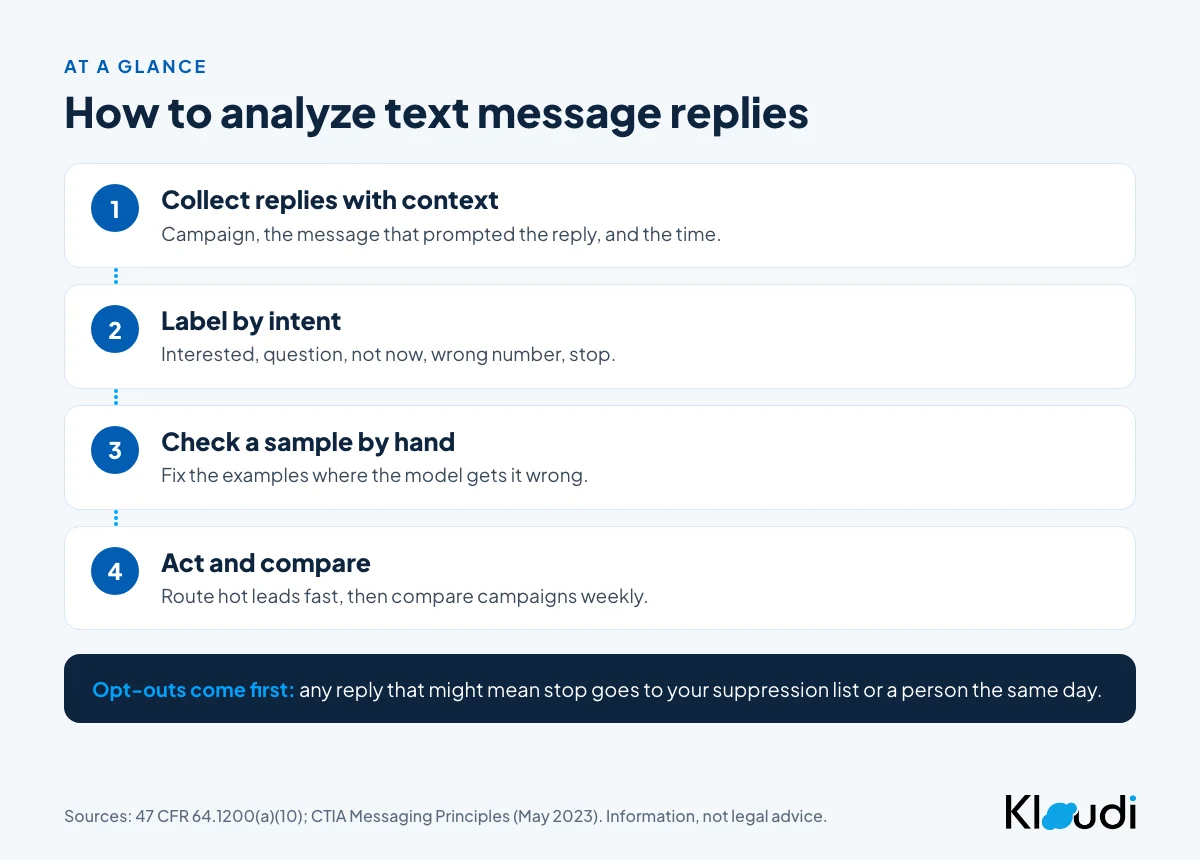
How do you analyze text messages, step by step?
- Collect replies with context. Keep the campaign, the message that prompted the reply and the time. If you text through Kloudi, webhooks can push inbound replies and opt-out events to your CRM or your own systems in real time.
- Pick a short label list. Five to seven intents is enough. More labels make results harder to act on.
- Label every reply. Run the replies through the model with your label list and a few examples of each.
- Check a sample by hand. Read a slice of each label every week. Fix the examples where the model is wrong.
- Act on the labels. Route interested leads to a person fast, answer common questions in your next message, and remove wrong numbers.
- Compare campaigns. Look at the label mix per campaign, not just the totals.
Why do opt-outs need special handling?
Because the rule does not depend on one keyword. Under the FCC’s rule, a consumer can revoke consent “by using any reasonable method,” and you must honor it within a reasonable time, no more than 10 business days (47 CFR 64.1200(a)(10)). CTIA’s Messaging Principles and Best Practices (May 2023, section 5.1.3) also say opt-out requests in normal language, such as “please opt me out,” should be read and acted on.
AI helps here, with one rule: it can flag a possible opt-out, but it should never be the reason you keep texting someone. Send anything that might be a stop request straight to your suppression list or to a person the same day.
What should you measure in text message replies?
A few numbers per campaign, reviewed weekly:
- Reply rate: how many people answered at all.
- Intent mix: the share of interested, question, not now and wrong-number replies.
- Opt-out rate: a rising rate is the earliest sign a sequence is too frequent or off-target.
- Wrong-number rate: a sign of list quality problems.
These numbers plug straight into your automation. Our guide to SMS marketing automation covers how to measure and tune automated sequences.
What about privacy when you analyze customer texts?
Replies carry personal information. CTIA (section 5.2.1) says senders should keep a privacy policy that clearly explains how they collect, use and share information, and treat information the way the policy says. Before you send customer messages to any AI tool, check that your policy covers that use, share only what the analysis needs, and limit who can see the results.
How does Kloudi fit into text message analysis?
Kloudi gives teams a structured inbox with agent assignment and campaign tagging through conversational texting. Text Automations can trigger auto-replies on keywords such as STOP, YES, INFO or CALL. Webhooks send replies and opt-out events to the tools you already use for analysis.
What to check with your counsel
- Does your privacy policy cover analyzing customer messages with AI tools?
- How fast do opt-outs found in free-form replies reach your suppression list?
- Do any state privacy laws that apply to you limit how you process message content?
Frequently asked questions
Can AI analyze text messages?
Yes. A model can label each reply by intent, pick out common questions and flag opt-out language. Have a person check a sample every week, and never let a model decide to keep texting someone who may have asked to stop.
Can AI detect opt-outs in text messages?
It can flag replies like “please stop texting me” that keyword rules miss. Treat every flagged reply as a possible opt-out: suppress the number or send it to a person the same day. Opt-outs must be honored within 10 business days at most.
What labels should I use to analyze text message replies?
Start with five: interested, question, not now, wrong number and stop. Add one only when a pattern keeps showing up that none of them covers.
What should I measure after I analyze text messages?
Reply rate, intent mix, opt-out rate and wrong-number rate for each campaign, compared week to week.
This article is general information, not legal advice. Talk to your own counsel about how these rules apply to your business.
Sources
- 47 CFR 64.1200 (current text, eCFR): https://www.ecfr.gov/current/title-47/chapter-I/subchapter-B/part-64/subpart-L/section-64.1200
- CTIA, Messaging Principles and Best Practices (May 2023), sections 5.1.3 and 5.2.1: https://api.ctia.org/wp-content/uploads/2023/05/230523-CTIA-Messaging-Principles-and-Best-Practices-FINAL.pdf