


The short version
- What changed: The FCC has confirmed that a text sent using an autodialer is a call under the TCPA, so TCPA text rules reach your lead messages.
- Who it affects: MCA brokers, ISOs and funders that text leads. Messages that advertise or constitute telemarketing need prior express written consent under 47 CFR 64.1200(a)(2).
- What to do: Keep a consent record for every lead, honor STOP and other revocation words, and screen lists before each campaign.
- When: Now. The FCC order cited here was adopted February 15, 2024.
Can MCA brokers text leads? Under the TCPA, the rules turn on whether the text is sent with an autodialer and whether it advertises or is telemarketing. The FCC has confirmed that a text sent using an autodialer is a call subject to the TCPA. Under 47 CFR 64.1200(a)(2), the consent needed depends on whether the message includes an advertisement or constitutes telemarketing. Check your own program with counsel.
What are the TCPA text rules for business messaging?
The TCPA restricts calls made with an autodialer or a prerecorded voice. The FCC wrote in its 2024 order (FCC 24-24) that “The Commission has confirmed that a text message sent using an autodialer is a call subject to the TCPA.” The statute, 47 U.S.C. 227(b)(1), is the starting point for that rule.
The FCC also describes the basic prohibition: “any non-emergency call made using an automatic telephone dialing system or an artificial or prerecorded voice” to a cellular number is restricted without prior express consent.
Our read: for an MCA text program, the first question is whether a given template is sent with an autodialer and whether it contains marketing. Write down which templates are marketing and which are informational before they go out.
Does marketing text need written consent?
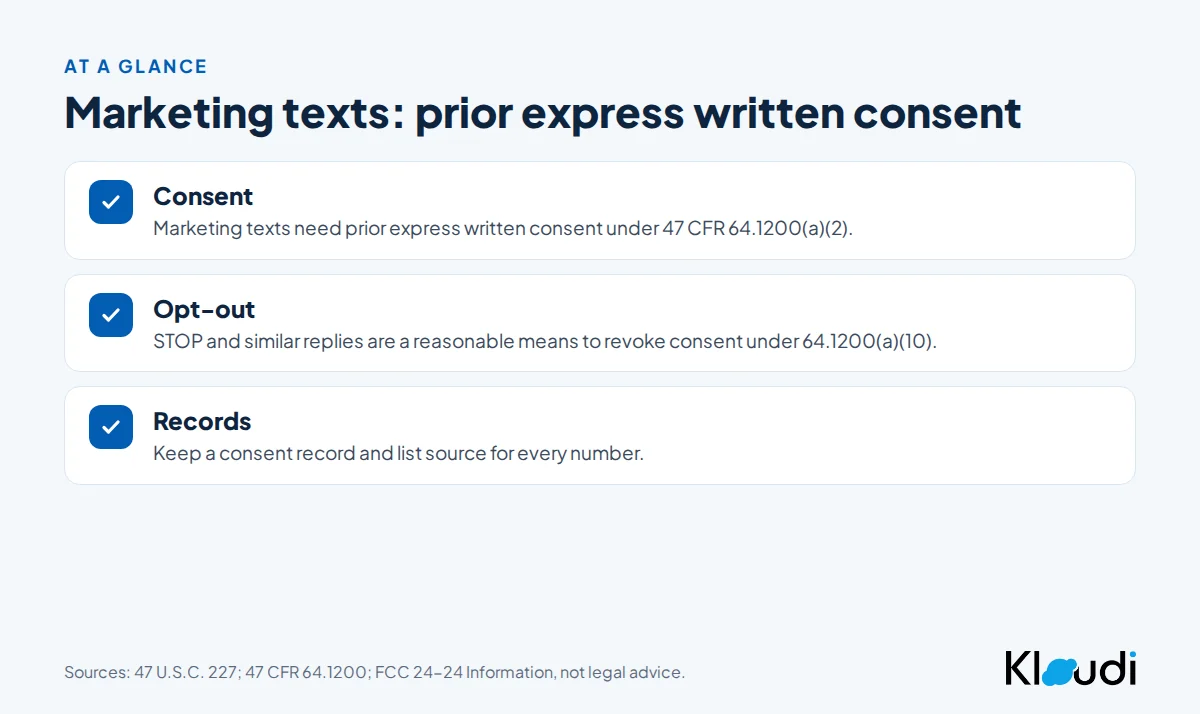
Under 47 CFR 64.1200(a)(2), a call that includes or introduces an advertisement or constitutes telemarketing needs “the prior express written consent of the called party.” The FCC order says the same thing: the rules require the caller to obtain prior express written consent for robocalls that introduce an advertisement or contain telemarketing.
Our read: application reminders and document requests are a different kind of message from promotions. Decide which side each template falls on, and check that call with counsel.
For MCA programs, the consent record matters as much as the wording. Keep a record of when each lead consented, where, and the exact language they saw. The MCA text program page describes the same habit: keep consent records for every lead.
What happens when a lead replies STOP?
The rule is specific. Under 47 CFR 64.1200(a)(10), replies using the words stop, quit, end, revoke, opt out, cancel, or unsubscribe “constitutes a reasonable means per se to revoke consent.” Once revoked, the caller “may not send additional robocalls and robotexts.”
The rule also covers wording outside that list. If a reply uses other words, the caller “must treat that reply text as a valid revocation request if a reasonable person would understand those words to have conveyed a request to revoke consent.”
Revocation requests “must be honored within a reasonable time not to exceed ten business days from receipt of such request.” Senders also “may not designate an exclusive means to request revocation of consent.”
Do do-not-call rules still apply to your lists?
The rules in 47 CFR 64.1200 require written do-not-call procedures: the sender must have “established and implemented written procedures to comply with the national do-not-call rules” and must train its personnel on them.
Our read: a written procedure you can show your team is worth more than a verbal one. Write down how you scrub, how often, and who signs off.
What this means for operators who text
The exposure is mostly in your records. The sender-side steps are straightforward.
- Keep a consent record for every number: when, where, and the exact language.
- Log each opt-out and the date it was processed.
- Record where each number on your list came from. If you buy leads, keep the consent record for each one.
- Scrub before each send. On Kloudi, “Before outbound campaigns are launched, contact lists can be screened against applicable Do Not Call databases.” See the DNC scrubbing and litigator suppression page for background.
Our read: if a demand letter arrived tomorrow, could you show when and how each number opted in? If not, fix that first.
What to check with your counsel
- Which of our templates count as marketing, and which are informational?
- Does our written consent language meet the prior express written consent standard for each template?
- How should we process STOP and other revocation words within the ten-business-day limit?
- Are our do-not-call procedures written down, and does our team know them?
Frequently asked questions
The FCC has confirmed that a text message sent using an autodialer is a call subject to the TCPA. Check how your messages are sent with counsel.
Under 47 CFR 64.1200(a)(10), STOP is a reasonable means per se to revoke consent. Requests must be honored within a reasonable time not to exceed ten business days.
The rules separate prior express consent from prior express written consent. Check each template against that split with counsel. This article is information, not legal advice.
Sources
- 47 U.S.C. 227
- 47 CFR 64.1200
- FCC 24-24, Report and Order on revoking consent
- MCA SMS marketing page
- DNC scrubbing and known litigator suppression
This article is general information, not legal advice. Talk to your own counsel about how these rules apply to your business.