


The short version
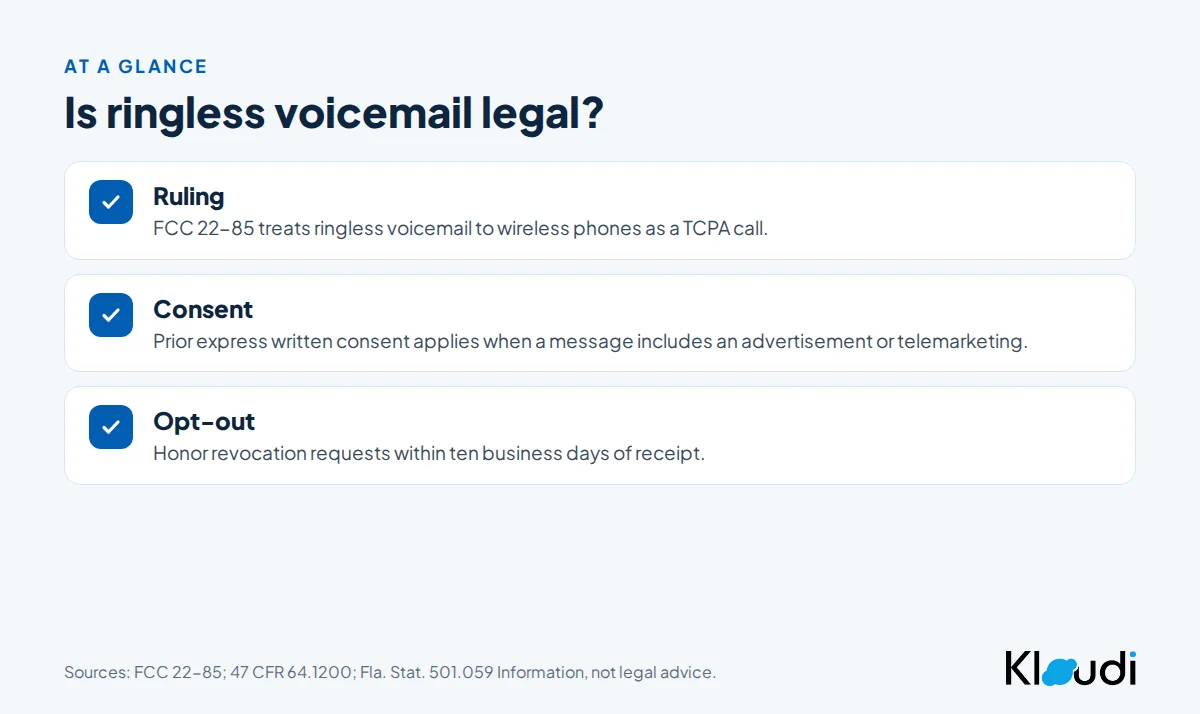
- What changed: The FCC ruled in November 2022 that ringless voicemail to wireless phones is a call under the TCPA that requires consumer consent.
- Who it affects: Anyone who sends RVM to mobile phones. Messages that include an advertisement or constitute telemarketing fall under a stricter consent rule.
- What to do: Keep a consent record for every number, scrub lists before sending, and log opt-outs by date.
- When: The FCC order was released November 21, 2022. Check your program with counsel now.
Is ringless voicemail legal? The FCC ruled in November 2022 that ringless voicemail to wireless phones is a call under the TCPA, so consumer consent applies. Which consent standard applies depends on whether the message includes an advertisement or constitutes telemarketing, under 47 CFR 64.1200(a)(1) and (a)(2).
Is ringless voicemail legal under the TCPA?
The FCC’s 2022 ruling (FCC 22-85) addresses this directly. The FCC found that “ringless voicemail” to wireless phones requires consumer consent because it is a “call” made using an artificial or prerecorded voice. The ruling sits under the Telephone Consumer Protection Act, codified in section 227 of the Communications Act. The FCC also concluded that ringless voicemail messages are calls subject to the TCPA “irrespective of content.”
What did the FCC rule in FCC 22-85?
The petitioner, All About the Message, LLC, asked the FCC to declare that ringless voicemail is not subject to section 227(b)(1)(A)(iii) of the TCPA. The FCC denied that request and also denied a retroactive waiver. The order was adopted November 14, 2022 and released November 21, 2022. You can read it in full at the FCC order, FCC 22-85.
For background on how RVM works and how it differs from a voicemail drop, see what ringless voicemail is.
Which consent rules apply to RVM?
Under 47 CFR 64.1200(a)(1), a call made using “an automatic telephone dialing system or an artificial or prerecorded voice” needs “the prior express consent of the called party,” unless the call is for emergency purposes or another listed exception applies.
Under 47 CFR 64.1200(a)(2), a call that “includes or introduces an advertisement or constitutes telemarketing” and uses a prerecorded voice needs “the prior express written consent of the called party” when it goes to the wireless lines covered by paragraph (a)(1)(iii). The message content decides which of these standards the rule reaches.
Our read: For lead and loan programs, the message content often decides which standard applies. A payment reminder and a sales offer can fall on different sides of that line. Have counsel map each message type to the consent it needs.
How do revocation and opt-outs work?
Under 47 CFR 64.1200(a)(10), a called party may revoke consent “by using any reasonable method to clearly express a desire not to receive further calls or text messages from the caller or sender.” Requests made in any reasonable manner “must be honored within a reasonable time not to exceed ten business days from receipt of such request.” Callers “may not designate an exclusive means to request revocation of consent.”
Replies using the words “stop,” “quit,” “end,” “revoke,” “opt out,” “cancel,” or “unsubscribe” are a reasonable means per se to revoke consent. Other reply words must be treated as a revocation request if a reasonable person would understand them to convey one.
What about do-not-call rules and calling hours?
The sources for this guide do not reproduce the do-not-call or calling-hour rules, so this article does not state what they require. Check those rules with counsel before you launch.
Can state law add rules to ringless voicemail?
Florida is one example in the sources. Under Fla. Stat. 501.059(8)(a), a person may not make an unsolicited telephonic sales call that plays “a recorded message when a connection is completed to a number called without the prior express written consent of the called party.” Whether that section reaches your program depends on whether your call is a telephonic sales call, which counsel should decide.
This guide does not cover California law. The sources used here do not address it.
What this means for operators who text
Treat every RVM drop as a prerecorded call to a mobile phone. Before you send, check three things: the consent record for each number, the exact language the person agreed to, and the message type. A consent record should show when and where each number opted in, and what the person was told.
Scrub lists before you send. Kloudi’s Compliance Shield™ includes optional suppression against known litigator datasets, and DNC scrubbing and litigator suppression can be applied before campaign deployment. Screening is a step on your side of the list, not a substitute for your own consent records.
Keep a record of where every number on your list came from. If a demand letter landed tomorrow, could you show when and how each number opted in? If not, fix that before the next drop.
Our read: Opt-out handling deserves the same care as the send. Log each revocation with its date, and process it inside the ten business day limit the rule sets.
What to check with your counsel
- Does each of our messages include an advertisement or constitute telemarketing under 47 CFR 64.1200(a)(2)?
- Which consent form and exact wording do we hold for each list segment?
- Do the do-not-call and calling-hour rules apply to our RVM program?
- Does any state law, including Fla. Stat. 501.059, reach our calls?
- Is our opt-out process fast enough to meet the ten business day limit?
Frequently asked questions
The FCC ruled that ringless voicemail to wireless phones requires consumer consent. Which consent standard applies depends on the message type under 47 CFR 64.1200(a)(2).
The FCC concluded that ringless voicemail messages are calls subject to the TCPA “irrespective of content.” Content still decides which consent standard applies under 47 CFR 64.1200(a)(1) and (a)(2).
Under 47 CFR 64.1200(a)(10), replies using words such as “stop” or “unsubscribe” are a reasonable means per se to revoke consent. Other replies count when a reasonable person would read them as a revocation request.
This is information, not legal advice. Talk to counsel about your program.
Sources
This article is general information, not legal advice. Talk to your own counsel about how these rules apply to your business.