


The short version
- What it is: ringless voicemail (RVM) places a prerecorded message in someone’s voicemail box without a normal ringing call.
- Who it affects: anyone who sends RVM to mobile phones. The FCC ruled in November 2022 (FCC 22-85) that it is a “call” under the TCPA, so the prerecorded-voice consent rules apply.
- What to do: keep a consent record for every number, scrub your list first, give a clear way to opt out, and have counsel review your use case.
- When it fits: short, expected messages that invite a callback, paired with SMS follow-up.
Ringless voicemail services deliver a prerecorded audio message straight into a recipient’s voicemail box, usually without the phone ringing. Since the FCC’s November 2022 ruling (FCC 22-85), RVM to wireless numbers is a prerecorded-voice “call” under the TCPA, so the same consent rules apply: prior express consent, or prior express written consent for marketing.
Kloudi offers ringless voicemail alongside SMS for teams in MCA, lead generation and call centers. This guide explains how RVM works, how it differs from a voicemail drop, which rules apply, and what to compare when you choose a provider.
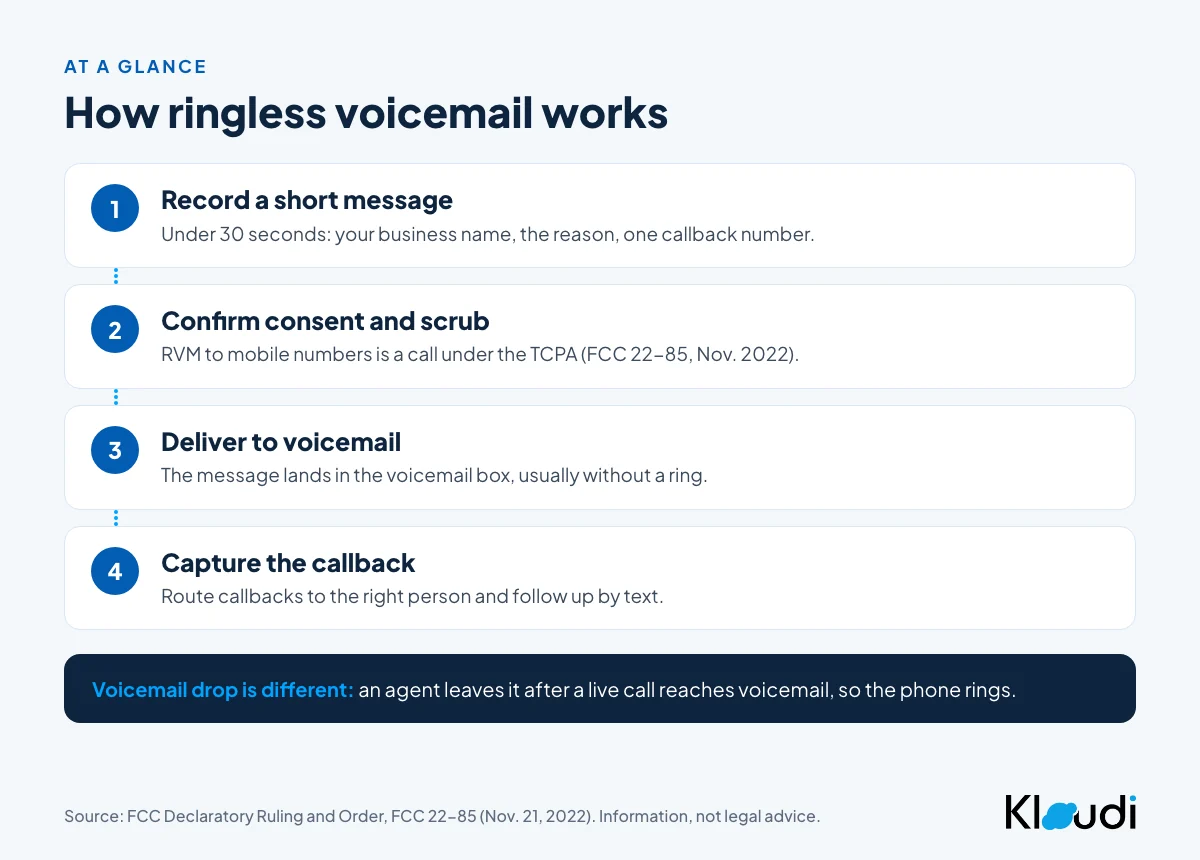
How does ringless voicemail work?
With a normal call, the phone rings, the person answers or misses it, and a voicemail may be left. With ringless voicemail, the intended flow skips the ring:
- You record the message. Short, clear, with your business name and a callback number.
- You select the audience and upload or sync the list.
- The delivery system submits the message toward each recipient’s carrier voicemail platform.
- The voicemail is deposited and appears in the recipient’s inbox.
- The recipient listens and calls back, and the callback is routed to your team.
The exact technical path depends on the provider and the carrier. Not every message reaches every mailbox: carrier behavior, full mailboxes, line type and recipient settings all play a part. Good ringless voicemail services report what was actually delivered, not just what was attempted.
What is the difference between ringless voicemail and a voicemail drop?
People use the terms interchangeably, but they are different tools.
- Voicemail drop is a dialer feature. An agent calls, the call reaches voicemail, and the agent clicks to leave a prerecorded message instead of recording it again. The phone does ring.
- Ringless voicemail sends the message toward the voicemail box without a live ringing call, usually as a campaign to many recipients.
Both save time on repetitive messages. Voicemail drop fits live calling teams. RVM fits campaigns where you want many people to hear the same short message and call back.
What rules apply to ringless voicemail?
In November 2022 the FCC found that “ringless voicemail” to wireless phones “requires consumer consent because it is a ‘call’ made using an artificial or prerecorded voice” under the Telephone Consumer Protection Act (FCC Declaratory Ruling and Order, FCC 22-85, CG Docket No. 02-278, released November 21, 2022). The FCC denied a petition from All About the Message, LLC, which had asked it to find that RVM is not covered by the TCPA.
For prerecorded calls to wireless numbers, the FCC’s rules at 47 CFR 64.1200 say:
- Consent depends on the message. An informational message needs the called party’s prior express consent (64.1200(a)(1)(iii)). A message that includes an advertisement or constitutes telemarketing needs prior express written consent (64.1200(a)(2)).
- Do Not Call rules apply to telephone solicitations, including to wireless numbers on the National Do Not Call Registry (64.1200(c) and (e)).
- Calling hours. Telephone solicitations may not be made before 8 a.m. or after 9 p.m., local time at the called party’s location (64.1200(c)(1)).
- Identification and opt-out. A prerecorded message must state the identity of the business at the beginning and give a telephone number (64.1200(b)(1) and (2)). A telemarketing message left on voicemail must also give a toll-free number that connects to an automated opt-out (64.1200(b)(3)).
- State laws can add rules. For example, Florida’s telephone solicitation law bars unsolicited telephonic sales calls that play a recorded message without the called party’s prior express written consent (Fla. Stat. 501.059(8)(a)).
Which of these apply depends on your message, your list and the states you send to. Check your program with your own counsel before you send. This is information, not legal advice.
What is ringless voicemail marketing used for?
The strongest RVM campaigns are short, relevant and expected. Common uses:
- Follow-up with existing contacts: a lead who requested a quote, an applicant missing a document, a customer with an open question.
- Reminders: appointments, renewals, events.
- Callback requests: “Call us back at this number about your request.”
- Multichannel campaigns: an RVM followed by a text with a link or a reply option.
RVM is not a numbers game. A smaller, relevant audience that agreed to hear from you performs better and creates less risk than a large generic list.
What should you compare in ringless voicemail services?
When you compare ringless voicemail services, look at the delivery infrastructure, not just the interface.
- Billing basis. Ask whether you pay per attempted send or per confirmed delivery. Per-delivery billing is easier to reconcile.
- Delivery reporting. Campaign-level confirmation of what landed, not only what was submitted.
- Callback handling. IVR, call forwarding, agent routing and campaign attribution, so a callback reaches the right person and you know which campaign drove it.
- List screening. DNC scrubbing, known litigator suppression and phone verification (line type matters: RVM goes to mobile voicemail) that can be applied before the campaign goes out.
- Opt-out handling. A clear way for recipients to stop future messages, and one suppression list shared with your SMS and calling.
- Geo and local presence options. Area code and region targeting.
- SMS in the same platform. RVM works best with a text follow-up and two-way replies.
- Pricing clarity. Per-delivery price, volume tiers and any platform fee.
How much do ringless voicemail services cost?
RVM pricing usually depends on volume, route and use case. Check whether a price is per attempt or per delivered voicemail, and whether a platform fee applies. On our RVM Delivery Engine page, pricing adjusts based on route alignment, industry risk profile, volume thresholds and geographic targeting, “at scale, pricing reaches sub-penny ranges,” and Kloudi bills on confirmed delivery events. Platform access is $99 per month and includes the RVM Delivery Engine, as listed on our pricing page on October 12, 2026.
What are the best practices for a ringless voicemail campaign?
- Keep it under 30 seconds. Name your business, say why you are calling, give one callback number.
- Sound like a person. Record it professionally, in a natural voice.
- Send to the right people. Only numbers with the right consent, scrubbed against the registry and your internal do-not-contact list.
- Send at reasonable times in the recipient’s time zone.
- Follow up by text with a short message and an opt-out line.
- Track callbacks and opt-outs by campaign, and stop sending to anyone who asks.
- Keep records: consent for each number, the recording you sent, the date, and every opt-out with the date you processed it.
How does Kloudi’s RVM Delivery Engine work?
Kloudi’s RVM Delivery Engine is our ringless voicemail infrastructure. As described on its product page, Kloudi bills on confirmed delivery events; the engine aligns campaigns based on industry profile, volume thresholds, carrier conditions and route stability; campaigns can be structured by area code and region; and every voicemail drop can route inbound callbacks through integrated IVR logic, with callback capture, call forwarding, agent routing and campaign-level tracking. Platform access also includes KloudiRoute (SMS), Text Automations and Conversation Texting, per our pricing page. If you send through Kloudi, our DNC scrub and known litigator screening can be applied to your list before a campaign goes out. It is a screening step, not a substitute for your own consent and opt-out records.
For the text side of a campaign, see our mass texting service guide. For turning callbacks into conversations, see SMS lead generation.
What to check with your counsel
- Is each RVM campaign informational, or does it include an advertisement or constitute telemarketing?
- Does our consent language meet the prior express written consent standard for the marketing messages?
- Which state laws apply to the numbers on our list, and what do they add?
- How do opt-outs from RVM callbacks, texts and calls reach one suppression list, and how fast?
FAQ
Does ringless voicemail make the phone ring?
It is designed not to. The message goes to the voicemail box and the recipient sees a new voicemail. Actual behavior can vary by carrier and device.
Do I need consent to send ringless voicemail?
The FCC’s November 2022 ruling (FCC 22-85) treats RVM to wireless numbers as a call made with a prerecorded voice, so the TCPA consent rules apply: prior express consent for informational messages and prior express written consent for marketing. Check your use case with counsel.
Is ringless voicemail the same as a voicemail drop?
No. A voicemail drop is left by an agent after a live call reaches voicemail, so the phone rings. Ringless voicemail is sent toward the voicemail box without a ringing call.
Can ringless voicemail be automated?
Yes. RVM can be triggered from a campaign or a workflow, for example after a form submission, and followed by an automatic text. Consent and opt-out rules still apply to every message.
What makes a good ringless voicemail service?
Delivery-confirmed reporting, clear pricing, callback routing, list screening before sends, opt-out handling and an SMS channel for follow-up.
This guide is information, not legal advice.