


The short version
- What it is: SMS outreach for lead generation means texting people who asked to hear from you, fast, then following up until they reply, book or opt out.
- Who it is for: lenders, brokers, agencies, call centers and lead-gen teams that work inbound inquiries at volume.
- What to do: reply within minutes, automate follow-up that stops on a response, and keep a consent record for every number.
- When it fits: right after a form, a quote request, a missed call or an application, while the lead is still engaged.
SMS outreach for lead generation is the practice of texting prospects who opted in, usually seconds or minutes after they inquire, to start a conversation and move them to the next step. It works because people read texts quickly. It works well only when the first reply is fast, the follow-up is automated but stops on a response, and every number has a consent record behind it.
We work with lenders, brokers, agencies and call centers whose pipelines depend on how fast and how well they follow up. Here is how we would set up SMS lead generation, and what to avoid.
What is SMS lead generation?
SMS lead generation uses text messages to engage and qualify prospects. It covers three jobs:
- Capture: a web form, landing page, ad or keyword (“Text QUOTE to…”) where a person gives a number and agrees to receive texts.
- Respond: the first text, ideally within minutes, acknowledging the inquiry and offering the next step.
- Follow up and qualify: a short sequence of texts, keyword triggers and two-way conversation that sorts interested leads from the rest and hands them to a person.
Text message lead generation does not mean texting a purchased list of strangers. Without consent, you create TCPA exposure and carrier filtering, and the list rarely converts.
Why does SMS outreach work for lead follow-up?
- Speed. A text can reach a lead within a minute of the inquiry, while a call might go unanswered.
- Low friction. A reply of YES or a time slot is easier than a callback.
- Two-way. Questions get answered in the same thread.
- Works with other channels. A text after a missed call, or after a ringless voicemail, gives the person a quick way to reply.
How do you set up an SMS lead generation campaign?
- Write consent into your capture points. Your forms should say who will text, what kind of messages, that message and data rates may apply, and how to opt out. Store when, where and the exact language each person agreed to.
- Register your 10DLC brand and campaign so the use case matches your forms and sample messages.
- Screen numbers before outreach: phone verification for line type and validity, your internal do-not-contact list, and the Do Not Call Registry for marketing messages unless you have the right consent.
- Send the first reply fast. Name your business, reference the inquiry and give one next step.
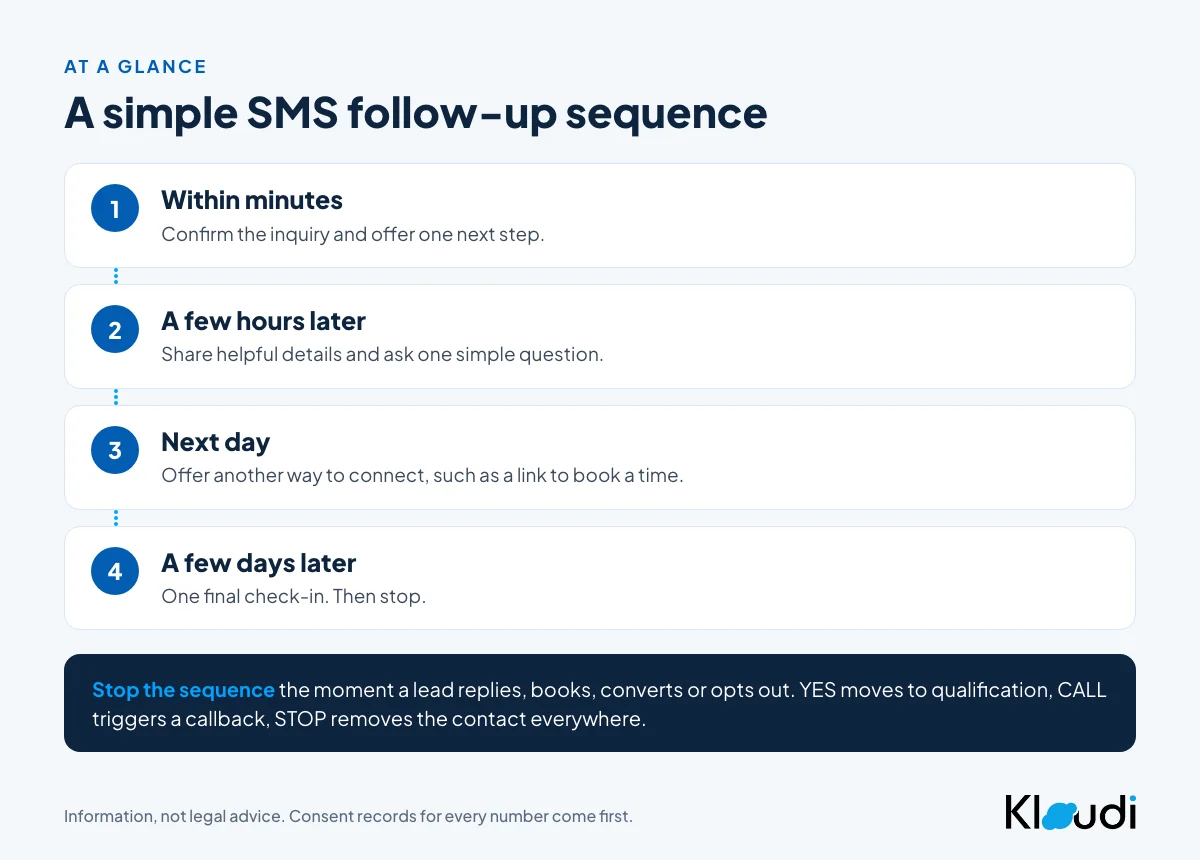
- Run a short sequence. Three or four messages over a few days is usually enough. Each one has a purpose.
- Branch on behavior. A YES moves to qualification, CALL triggers a callback, a question goes to a person, STOP removes the contact everywhere.
- Hand off to a person as soon as the lead is engaged.
- Measure reply rate, booked calls, conversions and opt-outs by campaign.
What does SMS automation for lead generation look like?
A simple automated follow-up sequence:
- Message 1, immediately: confirm the inquiry and ask for a reply. “Hi Sarah, it’s Mark at ABC Funding. Thanks for your request. Is now a good time for a quick call? Reply STOP to opt out.”
- Message 2, a few hours later: offer helpful information and ask one simple question.
- Message 3, next day: offer another way to connect, such as a link to book a time.
- Message 4, a few days later: a final check-in. Then stop.
The sequence should end the moment the lead replies, books, converts or opts out. Keyword triggers do the routing: YES to qualification, INFO to details, CALL to a callback flow, STOP to opt-out confirmation. Our supporting post on how to improve SMS lead follow-up goes deeper on timing, personalization and message examples.
Should you use an SMS lead generation agency or run it in-house?
Agencies running SMS for clients need the same foundation as an in-house team, multiplied by every client: a separate brand and campaign registration for each, separate lists and consent records, one suppression list per client that every campaign respects, and reporting by client. If you are an agency, set that structure up before the first send. If you hire an agency, keep your own consent records and suppression list; they are your records, and you will need them whoever sends.
What are the rules for SMS outreach to leads?
This is information, not legal advice. The main points for most senders:
- Consent. Marketing texts sent with automated systems generally require prior express written consent under the TCPA (47 CFR 64.1200(a)(2)). A form that names your business and the kind of messages is the usual way to get it.
- Opt-outs. A consumer can revoke consent by any reasonable method, and you must honor it within a reasonable time, no more than ten business days (47 CFR 64.1200(a)(10)).
- Do Not Call. The national registry rules apply to marketing texts sent to wireless numbers (47 CFR 64.1200(e)).
- Quiet hours. No telephone solicitations before 8 a.m. or after 9 p.m. at the recipient’s location. Some states are stricter.
- Lead sources. If a lead came from a third-party source, keep the consent record for that number: where, when and the exact language. If a lead cannot be traced to consent, do not text it.
Have counsel review your consent language and follow-up cadence before you scale.
Which metrics matter in SMS lead generation?
- Speed to first text: minutes from inquiry to first message.
- Reply rate: replies divided by leads texted.
- Positive response and booked-call rate.
- Lead-to-customer conversion rate by source and by sequence.
- Opt-out rate: a rising rate means the message, timing or audience is off.
- Delivery rate: a drop can point to registration or content problems.
If a sequence gets plenty of replies but few appointments, the issue is usually qualification or the handoff to sales, not the texts.
How does Kloudi support SMS lead generation?
Kloudi’s Text Automations run multi-day drip sequences, time-based intervals, conditional flows and keyword triggers (STOP, YES, INFO, CALL and custom keywords). Conversation texting gives your team a shared inbox for two-way replies, and AI Compose helps draft follow-up messages that your team reviews before sending. If you text through Kloudi, our DNC scrub and known litigator screening can be applied to your list before a campaign goes out. It is a screening step, not a substitute for your own consent and opt-out records. Pricing is on our pricing page.
To reach a larger opted-in list at once, see our mass texting service guide. To add a voice touch before the text, see what ringless voicemail is and how it works.
FAQ
What is SMS lead generation?
Using text messages to respond to, follow up with and qualify prospects who opted in, so more inquiries become conversations and customers.
Is SMS outreach legal for lead generation?
Yes, with the right consent. Marketing texts generally need prior express written consent, opt-outs must be honored within ten business days at most, and Do Not Call and quiet-hour rules apply. This is information, not legal advice.
How fast should I text a new lead?
Within minutes. The longer you wait, the more likely the lead has moved on or reached a competitor.
How many follow-up texts should I send?
Usually three or four over a few days, each with a clear purpose, and the sequence should stop as soon as the lead replies, books or opts out.
Can I text leads from a third-party source?
Only if you can show valid consent for each number to receive texts from your business. Keep the consent record: where, when and the exact language.
What is the difference between SMS lead generation and mass texting?
Lead generation is one-to-one follow-up triggered by a person’s inquiry. Mass texting sends one message to many opted-in contacts at once. Most teams use both.
This guide is information, not legal advice.