


The short version
- What it is: text blast software (a mass texting service) sends one message to a large list of people who agreed to hear from you, and handles the replies and opt-outs.
- Who it is for: businesses, nonprofits, lenders, agencies and call centers that text hundreds or thousands of contacts at once.
- What to do: register your brand and campaign (10DLC), screen your list before each send, and route every opt-out to one suppression list.
- When it fits: time-sensitive news, reminders and follow-ups that a person expects. It is not a fix for a cold or purchased list.
Text blast software is a mass texting service that sends one SMS to a large list of opted-in contacts at the same time, then tracks delivery, replies and opt-outs. A good one also helps you register your 10DLC campaign, screen numbers against Do Not Call and litigator lists before you send, and process STOP replies automatically.
We work with lenders, brokers, lead-gen teams, agencies and call centers that text every day. This guide covers what a mass texting service does, what separates a good one from a basic blaster, and the sender-side habits that keep a program running.
What is a mass texting service?
A mass texting service (also called bulk SMS, bulk texting, SMS bulk messaging or a text blast) lets you send the same message, with light personalization, to many people at once. You upload or sync a list, write the message, pick a send time and launch. The platform hands the messages to the carriers through registered business numbers and reports what happened.
Most people use it for:
- Promotions and announcements: a sale, a new product, a change in hours.
- Reminders: appointments, payments, document deadlines and events.
- Follow-ups: a reply to a quote request or an application, or a nudge after a missed call.
- Nonprofit outreach: fundraising updates, event reminders, volunteer coordination and member news for donors, volunteers and members.
- Internal alerts: shift changes or urgent notices for staff.
How is text blast software different from a basic texting app?
A phone or a basic texting app is built for one-to-one conversations. Text blast software is built for volume, and volume brings three problems a basic app does not solve.
- Carrier registration. US carriers expect business texts from local 10-digit numbers (10DLC) to come from a registered brand and campaign. Unregistered or mismatched traffic gets filtered or blocked.
- List hygiene. At volume, a few bad numbers become thousands: landlines, disconnected numbers, numbers on the Do Not Call Registry, people who opted out last month.
- Reply handling. A blast to 5,000 people can bring hundreds of replies in an hour, including STOP requests that must be honored.
So the question is not only “can it send a lot of texts?” It is “can it send them in a way carriers accept, to people who agreed, and handle what comes back?”
What should you look for in the best mass texting service?
Use this as a checklist when you compare bulk SMS services. It applies whether you send 2,000 texts a month or 200,000.
- 10DLC registration help. Brand and campaign registration, use-case alignment and a website that matches what you say in your campaign. Rejections usually come from mismatches between the website, the sample messages and the opt-in flow. Our guide to 10DLC campaign rejection lists the common reasons.
- List screening before you send. National and state Do Not Call scrubbing, known litigator suppression and phone verification (line type, carrier status, formatting) applied before a campaign goes out.
- Opt-out handling. STOP and the other standard keywords processed automatically, a confirmation text with no marketing in it, and one suppression list that every campaign respects.
- Two-way texting. A shared inbox or routing so a person can answer real questions, plus keyword triggers (for example YES or CALL) that move a contact to the next step.
- Automation. Drip sequences and follow-ups that stop when someone replies, books or opts out.
- Throughput control and reporting. The ability to pace sends, see delivery and reply rates by campaign, and spot problems early.
- Clear pricing. Know what you pay per outbound message, per inbound message, for screening and for the platform each month.
Be wary of any vendor that promises guaranteed delivery. No platform can guarantee it. Delivery depends on your registration, consent practices, content and volume.
How does a mass texting campaign work, step by step?
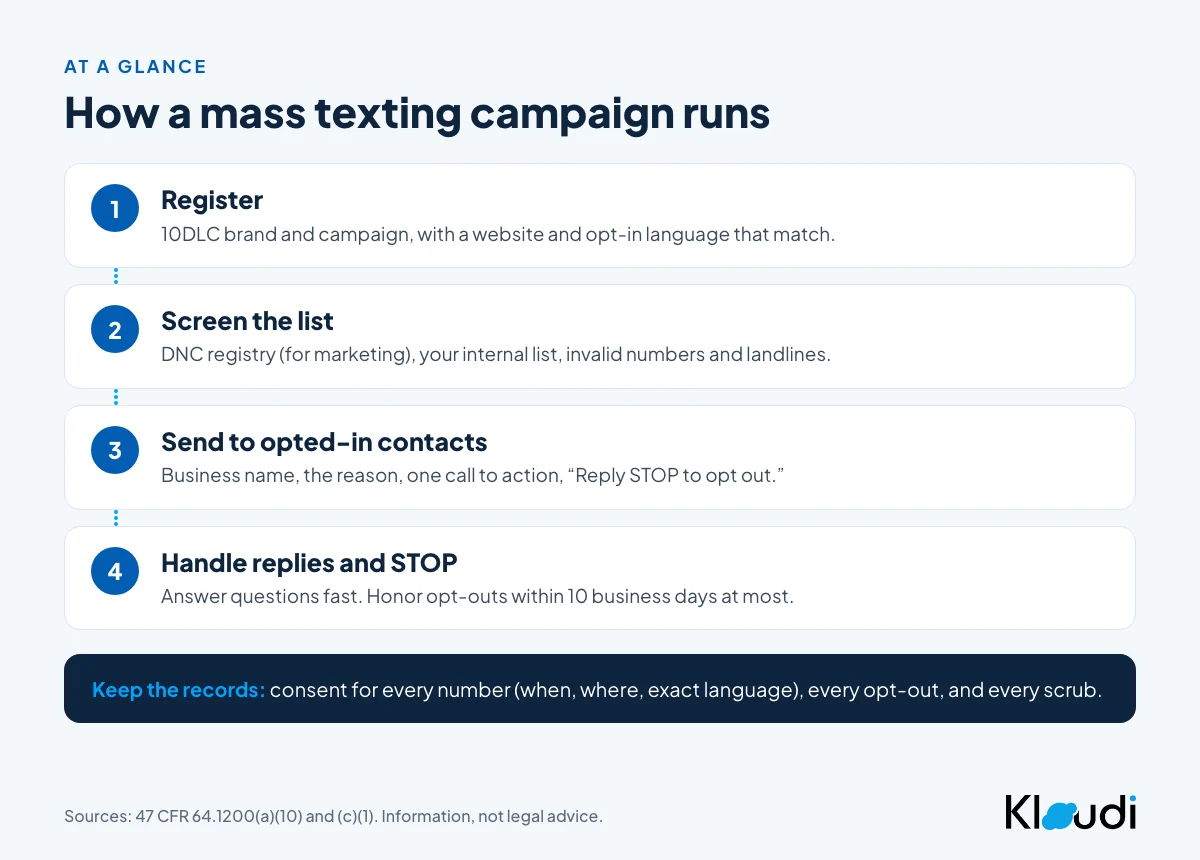
- Register. Submit your brand and campaign for 10DLC. Make sure your website has a privacy policy and terms, and that your opt-in language matches your campaign description.
- Build the list from consent. Use numbers from your own forms, customers and CRM, where you can show when and how each person agreed. Keep the record.
- Screen the list. Remove numbers on the Do Not Call Registry (for marketing), your internal do-not-contact list, known litigators if you choose to suppress them, invalid numbers and landlines.
- Write the message. Name your business, say why you are texting, keep it short, and include opt-out language such as “Reply STOP to opt out.”
- Schedule inside quiet hours. Federal rules bar telephone solicitations before 8 a.m. or after 9 p.m. at the recipient’s location (47 CFR 64.1200(c)(1)). Some states are stricter.
- Send in paced batches and watch delivery and opt-out rates on the first batch before releasing the rest.
- Answer replies and process opt-outs. Honor a revocation of consent within a reasonable time, no more than ten business days under 47 CFR 64.1200(a)(10). Faster is better.
- Review the numbers. Delivery rate, reply rate, opt-out rate and conversions, by campaign.
What does a mass texting service cost?
Pricing models vary. Some charge per message, some sell monthly bundles, and some add fees for inbound messages, numbers or registration. Compare the full cost of a campaign, not only the per-text price.
For reference, here is how Kloudi prices it, as listed on our pricing page on October 8, 2026:
- Setup: $398 one time, which includes a compliant website plus 10DLC brand and campaign registration ($299) and the first month of platform access ($99).
- Platform access: $99 per month.
- SMS: $0.025 per outbound SMS (base volume). No cost for inbound messages.
- Compliance screening: $0.005 per record, covering DNC scrubbing, known litigator suppression, phone verification and duplicate and malformed number suppression.
Is a free mass texting service worth it?
Free plans and free trials are fine for testing an interface. For real volume, free tools usually run into the same three walls: registration support, list screening and reply handling. If a tool cannot register your campaign properly or keep opt-outs consistent across campaigns, the cost shows up later as filtered traffic or complaints.
Which businesses use mass texting most?
- Lenders, brokers and ISOs: fast lead response, application and document reminders, and re-engagement. See our MCA SMS marketing guide.
- Lead generation teams: first touch and follow-up sequences. See our SMS lead generation guide.
- Call centers: callback requests, missed-call texts and appointment confirmations.
- Agencies: campaigns run for several clients, each with its own registration and list.
- Small businesses and nonprofits: promotions, reminders, fundraising updates and event news.
If you are comparing platforms more broadly, our guide to choosing SMS marketing software covers the features beyond mass sending.
What habits keep a mass texting program healthy?
These are the parts the sender controls, and they matter more than any platform feature.
- Keep consent records for every number: when, where (form, page or call) and the exact language the person agreed to.
- Know where every number came from: your own forms, your CRM or a lead source, with dates.
- Use one suppression list that every tool and every campaign respects, and process opt-outs from every channel.
- Scrub before each campaign against the registry and your internal list, and keep a record of each scrub.
- Respect quiet hours in the recipient’s time zone.
- Have counsel review your consent language, opt-out handling and record keeping before you scale.
How does Kloudi handle mass texting?
Kloudi’s mass texting platform runs on KloudiRoute, our managed SMS routing, with route-level throughput control, delivery monitoring and campaign reporting. Onboarding includes a compliant website and 10DLC brand and campaign registration. If you text through Kloudi, our DNC scrub and known litigator screening can be applied to your list before a campaign goes out. It is a screening step, not a substitute for your own consent and opt-out records. Text automations, two-way conversation texting and AI Compose for drafting are included in the platform.
FAQ
What is text blast software?
Text blast software sends one text message to a large list of contacts at the same time. It usually includes list upload, scheduling, personalization, opt-out handling, two-way replies and delivery reporting.
Is mass texting legal?
Yes, when you have the right consent and follow the rules. Marketing texts generally need prior express written consent under the TCPA, opt-outs must be honored, and Do Not Call and quiet-hour rules apply. This is information, not legal advice; talk to counsel about your program.
What is the difference between bulk SMS and mass texting?
None in practice. Bulk SMS, bulk texting, SMS bulk messaging, text blasts and mass texting all describe sending one message to many recipients at once.
Do I need 10DLC registration to send mass texts?
If you send business texts from local 10-digit numbers to US mobile users, carriers expect a registered brand and campaign. Unregistered traffic is likely to be filtered or blocked.
How many texts can I send at once?
It depends on your registration, your number type and your carrier throughput. A good platform paces sends and shows you delivery as it goes rather than pushing everything in one burst.
Can nonprofits use a mass texting service?
Yes. Nonprofits use mass texting for fundraising updates, event reminders, volunteer coordination and member news. The same consent, opt-out and registration rules apply.
This guide is information, not legal advice. Pricing is as listed on kloudi.ai/pricing on October 8, 2026.