

The short version
- What it is: a guide to running outbound SMS in lending, insurance, debt relief and other regulated fields, where carriers and regulators look harder.
- Who it affects: lenders, brokers, insurance agents, debt relief firms, call centers and the agencies that text for them.
- What to do: prove consent for every number, register an accurate 10DLC campaign, screen lists before each send and log every opt-out.
- When: before the first campaign, and again each time you add a lead source or a new message type.
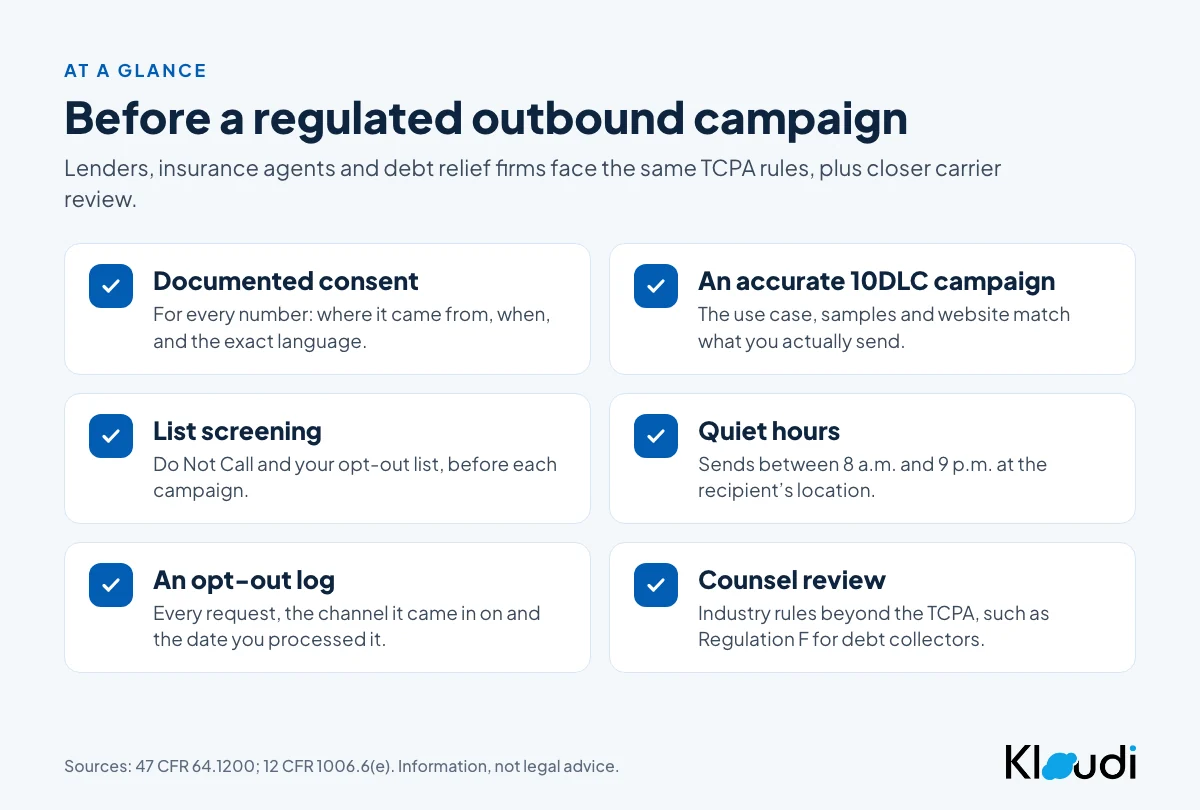
SMS for financial services works when every number has documented consent, the 10DLC campaign describes what you actually send, lists are screened against Do Not Call and opt-out records before each campaign, and messages go out within quiet hours. Lenders, insurance agents and debt relief firms face the same TCPA rules as everyone else, plus closer carrier review.
Why is texting harder in regulated industries?
Three things stack up:
- The TCPA applies to everyone. Marketing texts need the right consent, opt-outs must be honored within 10 business days, and Do Not Call and quiet-hour rules apply (47 CFR 64.1200). Lenders and insurance agents text consumers who often came in through lead forms, which is where consent gaps show up.
- Industry rules add more. A debt collector texting a consumer must include a clear and conspicuous way to opt out in each electronic message (Regulation F, 12 CFR 1006.6(e)). Other financial products have their own disclosure rules.
- Carriers look harder. 10DLC campaigns in lending, debt relief and lead generation get a closer review of the use case, the opt-in flow, the sample messages and the website. Our list of common 10DLC campaign rejection reasons covers restricted content and lead-generation concerns. To see how your own website reads before you submit, run it through our free 10DLC website checker.
What should a texting platform for financial services do?
Look for controls that run before a message is sent, not only reports after:
- List screening against national and state Do Not Call lists, with an optional known litigator suppression step.
- Phone number verification to catch invalid numbers and line types before you pay to send.
- Automatic opt-out handling that recognizes STOP and similar replies and syncs them to your other systems.
- 10DLC registration support, so the brand and campaign match what you send.
- Two-way messaging with a team inbox, so replies reach a person.
- Automation with guardrails: drip sequences that stop on reply and on opt-out.
- Delivery reporting by campaign.
None of these replace your own consent records or counsel review. They make the checklist easier to run at volume.
How do lenders, brokers and insurance agents use SMS?
- Lead follow-up: a text within minutes of an inquiry, then a short sequence.
- Application status: document requests, approvals and next steps.
- Appointment reminders for calls and meetings.
- Renewals and policy reminders for insurance customers who opted in.
- Callback routing from replies to the right rep.
Merchant cash advance brokers and ISOs have their own playbook; see our SMS marketing guide for MCA brokers. Healthcare teams should start with our page on SMS for healthcare, and contact centers with call center SMS.
How do you run outbound SMS outreach at volume?
Outbound outreach to a large list is where most problems start. What we would check before each campaign:
- Where every number came from. Your own forms, your CRM or a lead source, with dates. If you buy leads, keep the consent record for every number: where, when and the exact language.
- Consent covers your business by name. Generic “partners may contact you” language is a weak record.
- The list was scrubbed against Do Not Call and your internal opt-out list for this campaign.
- The message matches the registered campaign, with your business name and opt-out instructions.
- Sends are scheduled between 8 a.m. and 9 p.m. at the recipient’s location (47 CFR 64.1200(c)(1)).
What makes an SMS platform high deliverability?
Deliverability is mostly decided by the sender: a registered campaign, clean lists, consistent content and low complaint and opt-out rates. Platform features help (route monitoring, number verification, delivery reporting), but no provider can promise that carriers will deliver every message. Our guide to SMS delivery issues covers the common causes and fixes.
What do enterprise teams need from an AI text message marketing tool?
At enterprise volume, AI helps most with drafting and triage: generating template variations, suggesting replies and routing conversations. Keep a person in the loop:
- Review AI-drafted templates before they go into a live campaign.
- Check that every variation includes your business name and opt-out instructions.
- Route unclear or sensitive replies, and anything that reads like a request to stop, to a person.
Our guide to SMS marketing automation covers sequences, reminders and AI replies in more detail.
How does Kloudi work for regulated senders?
Kloudi is built for regulated and performance-driven senders. Compliance Shield includes national and state DNC scrubbing, optional known litigator suppression, phone verification and 10DLC campaign support. If you text through Kloudi, our DNC scrub and known litigator screening can be applied to your list before a campaign goes out. It is a screening step, not a substitute for your own consent and opt-out records.
What to check with your counsel
- Which federal and state rules apply to your product, beyond the TCPA?
- Does your lead-form consent language name your business and cover marketing texts?
- If you collect debts or work with collectors, does each text include the opt-out notice Regulation F requires?
- How do opt-outs from lead sources, affiliates and every tool reach one suppression list?
Frequently asked questions
Can financial services companies send marketing texts?
Yes, with prior express written consent for marketing texts sent with an autodialer, a working opt-out, Do Not Call scrubbing, quiet hours and a registered 10DLC campaign. Industry rules, such as Regulation F for debt collectors, can add requirements.
Why do carriers reject lending and debt relief campaigns?
Carriers review these categories more closely. Common reasons include unclear consent, a website that does not match the campaign, sample messages that do not fit the use case and lead-generation or affiliate concerns.
What is a known litigator scrub?
A check of your list against phone numbers associated with repeat TCPA lawsuits, so you can choose to suppress them before a campaign. It is a risk-reduction step, not a substitute for consent.
What makes an SMS platform good for regulated industries?
Screening before the send (DNC, litigator suppression, number verification), automatic opt-out handling, 10DLC registration support, two-way messaging and delivery reporting.
This guide is general information, not legal advice. Talk to your own counsel about how these rules apply to your business.
Sources
- 47 CFR 64.1200 (current text, eCFR): https://www.ecfr.gov/current/title-47/chapter-I/subchapter-B/part-64/subpart-L/section-64.1200
- 47 U.S.C. 227 (Telephone Consumer Protection Act): https://www.law.cornell.edu/uscode/text/47/227
- Regulation F, 12 CFR 1006.6: https://www.law.cornell.edu/cfr/text/12/1006.6
- CTIA, Messaging Principles and Best Practices (May 2023): https://api.ctia.org/wp-content/uploads/2023/05/230523-CTIA-Messaging-Principles-and-Best-Practices-FINAL.pdf
- The Campaign Registry (10DLC brand and campaign registration): https://www.campaignregistry.com/