

The short version
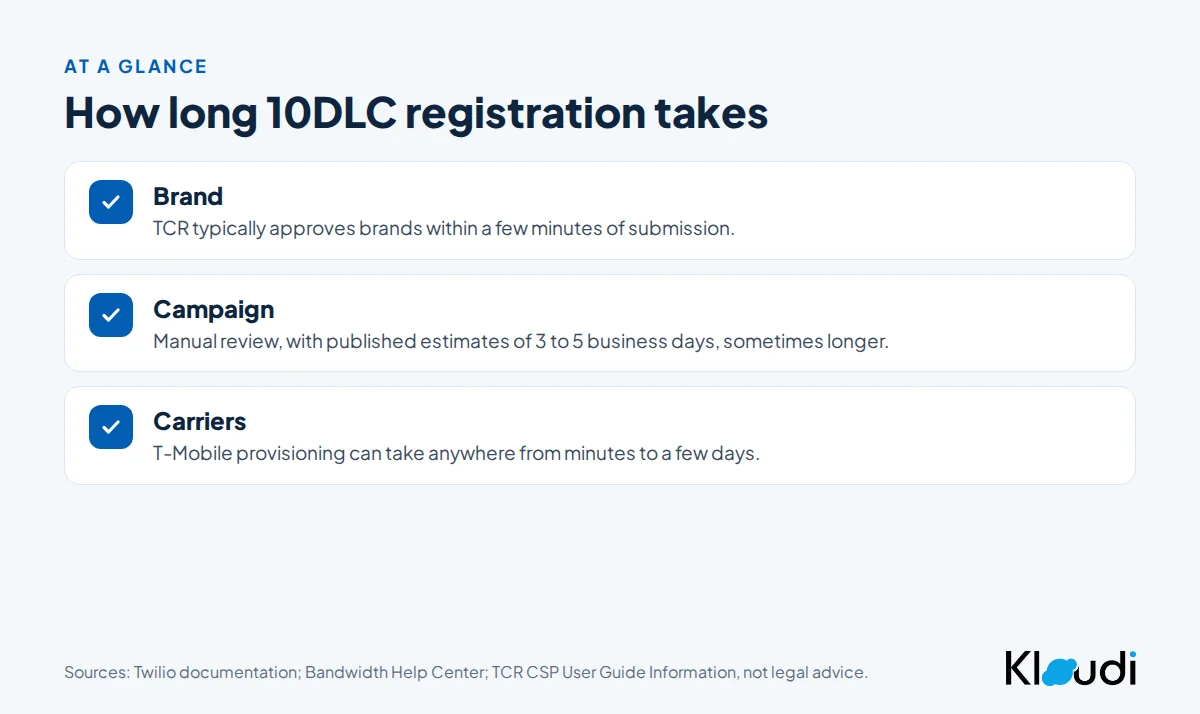
- The answer: There is no single clock. Brand verification can clear in minutes. Campaign review is done by hand, and published estimates run 3 to 5 business days, sometimes longer.
- Who it affects: Any business that sends application-to-person texts from a US 10-digit number, and anyone planning a launch date around approval.
- What to do: Check that the brand record matches your tax records, keep the website, opt-in and sample messages ready before you submit, and register early.
- When: Timelines checked November 13, 2026 against published documentation.
How long does A2P 10DLC registration take? Published provider documentation says The Campaign Registry typically approves brands within a few minutes, and that campaign reviews take up to 5 business days for standard use cases. One provider expects 3-5 business days for the first campaign review and says it could be longer.
What are the steps in A2P 10DLC registration?
Our read: think of it as three steps in a row, where the brand is verified, the campaign is reviewed, and the phone numbers are provisioned with the carriers.
| Step | Who handles it | Published timing |
|---|---|---|
| Brand registration | The Campaign Registry (TCR) | “typically approves brands within a few minutes of submission” (Twilio documentation) |
| Campaign review | A Direct Connect Aggregator (DCA), by hand | “up to 5 business days for standard use cases” (Twilio documentation); “3-5 business days for the initial review of a campaign, but it could be longer” (Bandwidth Help Center) |
| Number provisioning | T-Mobile’s provisioning platform, for the T-Mobile portion | “can take anywhere from minutes to a few days” (Bandwidth Help Center) |
Our read: add the steps together and plan on one to two weeks for a clean first submission, and longer if anything comes back rejected.
Why is campaign review the slow step?
Because a person reads it. Bandwidth’s Help Center article on campaign vetting, dated August 14, 2026, says the carriers found that campaigns “weren’t being registered appropriately,” so newly created campaigns now go through a manual review and wait in a pending status until it is done.
The same article says “this review is done by the downstream Direct Connect Aggregator (DCA), not The Campaign Registry (TCR).” It also says a phone number cannot be associated with a campaign until the campaign is fully approved, and that campaigns the DCA has not approved “are subject to blocking from the wireless carriers.”
Twilio’s A2P 10DLC documentation gives its own customers a checkpoint: “If your campaign is still in progress after 10 days, reach out to Support.”
Our read: if nothing has moved in ten days, check the status instead of waiting.
What slows 10DLC approval down?
Most delays start in the submission, which is the part you control.
- A brand that is not verified. TCR’s CSP User Guide (July 2026) says “Unverified Brands cannot register 10DLC campaigns.” The guide says an unverified brand can be updated and resubmitted for verification. Check that the registered business name, tax ID and address on the brand match your tax records before you submit.
- An unanswered verification email. Some brand vets need a business contact to answer a verification email. TCR’s guide says that email “contains a PIN that is valid for 7 days.” Check the business contact inbox every day while a vet is open.
- Samples and opt-in that are not ready. Twilio’s documentation asks for sample messages “that relate to the campaign description,” says a website link “must be a real, functional business website,” and says to “Indicate an opt-out mechanism in every message.” It also asks for “an opt-in method that TCR can verify.” Read more in the website requirements guide before you submit.
- Repeat rejections. Bandwidth’s Help Center describes a rejection code for a campaign “submitted four or more times without resolving the underlying issues.” Read more on the common campaign rejection reasons and fix everything in one pass.
What this means for operators who text
- Register before you need to send. Bandwidth’s own advice is to “plan accordingly and register as early as possible.”
- Keep launch dates, lead buys and ad spend off the approval date. Our read: every published number is an estimate, and each one comes with a “could be longer.”
- Read more about the compliance checker, then run your website through it before you submit.
- Keep one record of what you submitted: brand details, campaign description, sample messages and opt-in screenshots. A resubmission goes faster when you can see what the reviewer saw.
- Kloudi’s pricing page lists “Compliant Website + 10DLC Registration.” Read more on the registration service page.
What to check with your counsel
- Does our opt-in language match the messages we plan to send?
- Does our privacy policy say what we do with mobile numbers and opt-in data?
- Does the campaign description match the program we run, including who we text and where their numbers came from?
Frequently asked questions
Twilio's documentation says The Campaign Registry typically approves brands within a few minutes of submission.
Published estimates are up to 5 business days for standard use cases (Twilio documentation) and 3-5 business days for the initial review, possibly longer (Bandwidth Help Center).
Bandwidth's Help Center says the review is done by the downstream Direct Connect Aggregator (DCA), not The Campaign Registry (TCR).
Bandwidth's Help Center says campaigns in any state other than approved by the DCA are subject to blocking from the wireless carriers. This article is information, not legal advice.
Sources
- A2P 10DLC registration application quickstart (Twilio documentation)
- 10DLC campaign vetting and phone number provisioning process (Bandwidth Help Center, August 14, 2026)
- CSP User Guide, July 2026 (The Campaign Registry)
This article is general information, not legal advice. Talk to your own counsel about how these rules apply to your business.