


The short version
- The answer: The FCC rule bars telephone solicitations to numbers on the national do-not-call registry and applies to text messages to wireless numbers. Its protection for mistakes calls for a registry version no more than 31 days old.
- Who it affects: Anyone who sends a telephone solicitation, which the FCC rule defines as a call or message “for the purpose of encouraging the purchase or rental of, or investment in, property, goods, or services.”
- What to do: Scrub the list against the Do Not Call Registry before each campaign, keep a record of every scrub, and keep your own do-not-call list.
- When: Rule text read November 23, 2026 on the eCFR and the FTC’s website.
Do you need to scrub a text list against the Do Not Call Registry? The FCC’s rule, 47 CFR 64.1200(c)(2), bars telephone solicitations to residential subscribers who registered their numbers, and paragraph (e) applies that rule to text messages to wireless numbers. Its safe harbor for mistakes calls for a registry version obtained no more than 31 days before the message.
What does the FCC rule say about the Do Not Call Registry?
47 CFR 64.1200(c)(2) says no person or entity shall initiate any telephone solicitation to “A residential telephone subscriber who has registered his or her telephone number on the national do-not-call registry.”
The same paragraph says “Such do-not-call registrations must be honored indefinitely, or until the registration is cancelled by the consumer or the telephone number is removed by the database administrator.”
Paragraph (e) says the rules in paragraphs (c) and (d) “are applicable to any person or entity making telephone solicitations or telemarketing calls or text messages to wireless telephone numbers.”
Read more in our write-up on the Do Not Call Registry and text messages.
How often do you have to scrub?
Both federal rules use the same number, 31 days.
| Rule | What it says |
|---|---|
| FCC, 47 CFR 64.1200(c)(2)(i)(D) | “employing a version of the national do-not-call registry obtained from the administrator of the registry no more than 31 days prior to the date any call is made, and maintains records documenting this process” |
| FTC, 16 CFR 310.4(b)(3)(iv) | “obtained from the Commission no more than thirty-one (31) days prior to the date any call is made, and maintains records documenting this process” |
| FTC guidance for telemarketers and sellers | “you must synchronize your lists with an updated version of the registry at least every 31 days” |
The FTC’s Telemarketing Sales Rule speaks of an “outbound telephone call.” The FCC rule names text messages in paragraph (e).
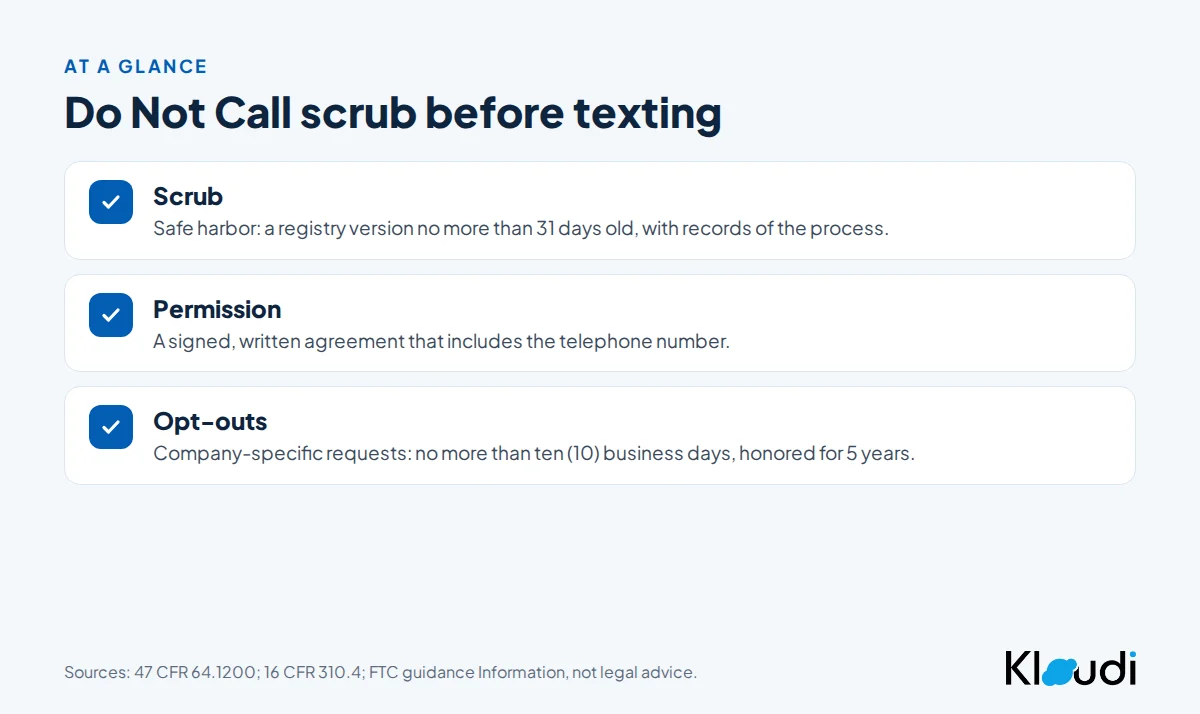
In the FCC rule, the 31-day version is one part of a safe harbor. A sender “will not be liable for violating this requirement” if it can show that the violation “is the result of error” and that its routine business practice meets five standards:
- “It has established and implemented written procedures to comply with the national do-not-call rules.”
- “It has trained its personnel, and any entity assisting in its compliance, in procedures established pursuant to the national do-not-call rules.”
- “It has maintained and recorded a list of telephone numbers that the seller may not contact.”
- It uses the 31-day registry process and keeps records documenting it.
- “It purchases access to the relevant do-not-call data from the administrator of the national database and does not participate in any arrangement to share the cost of accessing the national database.”
Our read: an old scrub, or a scrub with no record behind it, does not line up with that safe harbor.
When does the registry rule not apply?
The text of the FCC rule includes these carve-outs, and each one has a limit.
- Signed, written permission. Paragraph (c)(2)(ii) covers a sender that “has obtained the subscriber’s prior express invitation or permission.” It adds: “Such permission must be evidenced by a signed, written agreement between the consumer and seller which states that the consumer agrees to be contacted by this seller and includes the telephone number to which the calls may be placed.”
- An established business relationship. Paragraph (f)(15) says a telephone solicitation does not include a call or message “To any person with whom the caller has an established business relationship.” Paragraph (f)(5) bases that relationship on a purchase or transaction “within the eighteen (18) months immediately preceding the date of the telephone call” or an inquiry or application “within the three months immediately preceding the date of the call.”
- An opt-out ends that relationship. Paragraph (f)(5)(i) says a seller-specific do-not-call request “terminates an established business relationship for purposes of telemarketing and telephone solicitation even if the subscriber continues to do business with the seller.”
The FTC’s guidance says this about the FTC’s own rule: “Most phone calls to a business made with the intent to solicit sales from that business are exempt from the Do Not Call provisions.”
Our read: treat a business owner’s cell phone as a question for counsel, not as a number that sits outside the registry rule.
What about your own do-not-call list?
The registry is one list. Paragraph (d) of the FCC rule calls for a second one: a telemarketer needs “procedures for maintaining a list of persons who request not to receive such calls made by or on behalf of that person or entity.”
- A written policy. Paragraph (d)(1) says telemarketers “must have a written policy, available upon demand, for maintaining a do-not-call list.”
- Ten business days. Paragraph (d)(3) says a request is honored “within a reasonable time from the date such request is made,” and “This period may not exceed ten (10) business days from the receipt of such request.”
- Five years. Paragraph (d)(6) says “A do-not-call request must be honored for 5 years from the time the request is made.”
What does registry access cost?
16 CFR 310.8(c) sets the annual fee at “$85 for each area code of data accessed, up to a maximum of $23,425” and says “there shall be no charge to any person for accessing the first five area codes of data.”
The FTC’s guidance says the same: “Beginning October 1, 2026, the annual fee will be $85 per area code of data (after five) up to a maximum annual fee of $23,425.”
What this means for operators who text
- Scrub every marketing list against the registry before each campaign, and scrub again when the last scrub is more than a month old.
- Keep a dated record of every scrub: the list, the registry version and the result.
- Keep signed, written permission on file with the phone number in it, and match each lead to its record before you rely on it.
- Honor every opt-out on your own list quickly, and keep it there.
- Kloudi’s product page says “contact lists can be screened against applicable Do Not Call databases” before outbound campaigns are launched, and lists “DNC Scrubbing + Known Litigator Suppression $0.005 per record.” Read more on the DNC scrubbing page.
- Read more on texting MCA leads if you buy or broker business leads.
What to check with your counsel
- Do the numbers we text count as residential subscribers under the FCC rule, including cell phones that business owners use for work?
- Does our opt-in form create a signed, written agreement that names us and includes the phone number?
- Do state do-not-call lists apply in the states we text into?
- Who in our company holds the registry subscription and the scrub records?
Frequently asked questions
Both federal rules use 31 days. The FTC's guidance says "you must synchronize your lists with an updated version of the registry at least every 31 days."
47 CFR 64.1200(e) applies the registry rule to "telephone solicitations or telemarketing calls or text messages to wireless telephone numbers."
The FCC rule says registrations "must be honored indefinitely, or until the registration is cancelled by the consumer or the telephone number is removed by the database administrator."
The FCC rule says "A do-not-call request must be honored for 5 years from the time the request is made." This article is information, not legal advice.
Sources
- 47 CFR 64.1200, Delivery restrictions (eCFR)
- 16 CFR 310.4, Abusive telemarketing acts or practices (eCFR)
- 16 CFR 310.8, Fee for access to the National Do Not Call Registry (eCFR)
- Q&A for Telemarketers & Sellers About DNC Provisions in TSR (Federal Trade Commission)
This article is general information, not legal advice. Talk to your own counsel about how these rules apply to your business.