

The short version
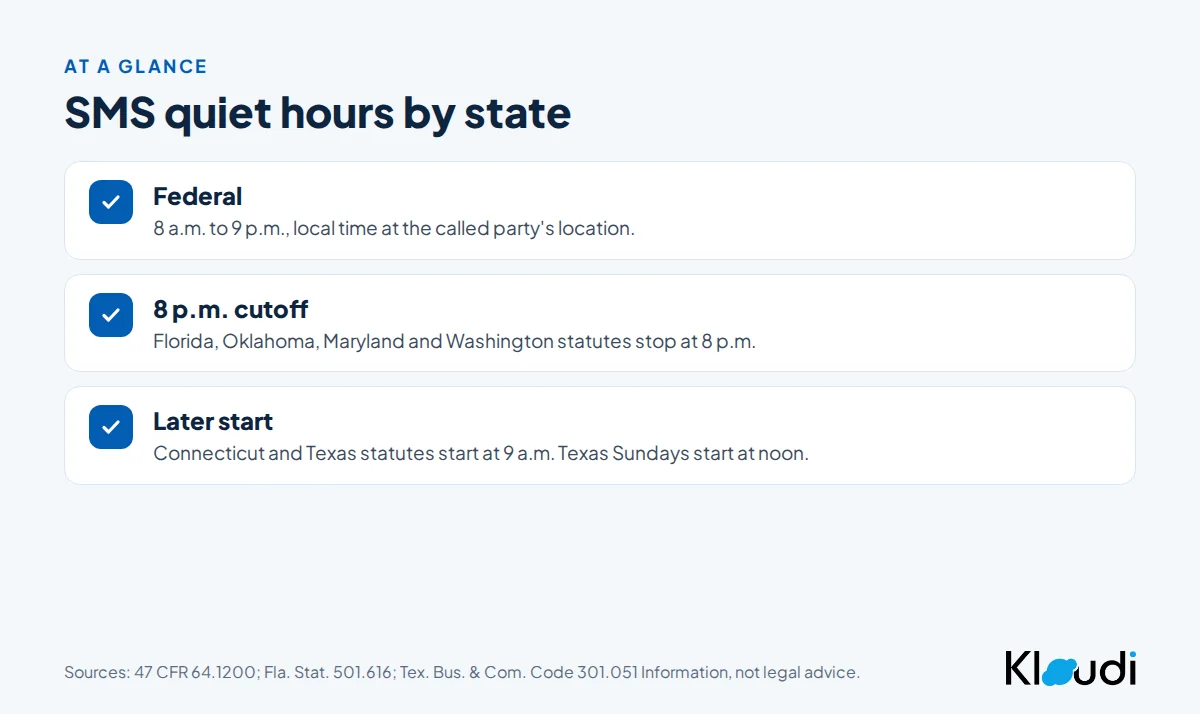
- The rule: 47 CFR 64.1200(c)(1) bars telephone solicitations to residential subscribers before 8 a.m. or after 9 p.m., local time at the called party’s location.
- Who it affects: Anyone sending marketing texts across state lines. Statutes in Florida, Oklahoma, Maryland and Washington stop at 8 p.m. Connecticut and Texas start at 9 a.m.
- What to do: Schedule by the recipient’s time zone, use the tightest window you send into, and have counsel confirm which statutes reach your texts.
- When: Statute text read November 13, 2026. State rules change, so recheck before each new market.
SMS quiet hours start with the federal rule. 47 CFR 64.1200(c)(1) sets the window for telephone solicitations to residential subscribers at 8 a.m. to 9 p.m. in the recipient’s local time. Several states write a shorter window into their own telemarketing statutes. Which of those statutes reach your texts is a question for counsel.
What are the federal SMS quiet hours?
47 CFR 64.1200(c)(1) says no person or entity shall initiate any telephone solicitation to “any residential telephone subscriber before the hour of 8 a.m. or after 9 p.m. (local time at the called party’s location).”
Paragraph (e) of the same section says the rules in paragraph (c) “are applicable to any person or entity making telephone solicitations or telemarketing calls or text messages to wireless telephone numbers,” to the extent described in the FCC’s 2003 order (FCC 03-153).
The rule defines a telephone solicitation as “the initiation of a telephone call or message for the purpose of encouraging the purchase or rental of, or investment in, property, goods, or services.” The definition leaves out a call or message “to any person with that person’s prior express invitation or permission” and one “to any person with whom the caller has an established business relationship.”
Our read: do not treat an opt-in as a pass on the clock until counsel has signed off on that for your program. Read the court split on text messages and the do-not-call rules before you assume the federal window does or does not reach your texts.
Which states set tighter hours?
Seven state statutes, each read on the state’s own website on November 13, 2026. This is not a full fifty-state list.
| State | Window in the statute | Citation |
|---|---|---|
| Federal | 8 a.m. to 9 p.m. | 47 CFR 64.1200(c)(1) |
| Florida | 8 a.m. to 8 p.m. | Fla. Stat. 501.616(6)(a) |
| Oklahoma | 8 a.m. to 8 p.m. | 15 O.S. 775C.4 |
| Maryland | 8 a.m. to 8 p.m. | Md. Code, Commercial Law 14-4502(c) |
| Washington | 8 a.m. to 8 p.m. | RCW 80.36.390(8) |
| Connecticut | 9 a.m. to 8 p.m. | Conn. Gen. Stat. 42-288a(c) |
| Texas | 9 a.m. to 9 p.m., and noon to 9 p.m. on Sunday | Tex. Bus. & Com. Code 301.051 |
| Virginia | 8 a.m. to 9 p.m. | Va. Code 59.1-511 |
Florida. Fla. Stat. 501.616(6)(a) bars “a commercial telephone solicitation phone call before 8 a.m. or after 8 p.m. local time in the called person’s time zone.” Paragraph (b) bars more than three such calls “from any number to a person over a 24-hour period on the same subject matter or issue.”
Oklahoma. 15 O.S. 775C.4, the Telephone Solicitation Act of 2022, uses the same 8 a.m. and 8 p.m. limits “in the called person’s time zone” and the same cap of three calls in a twenty-four-hour period.
Maryland. Md. Code, Commercial Law 14-4502(c) bars a telephone solicitation “to a called party during the hours between 8 p.m. and 8 a.m. in the called party’s time zone,” and more than three times to the same called party in a 24-hour period on the same subject.
Washington. RCW 80.36.390(8) says “A telephone solicitor shall not place calls to any person which will be received before 8:00 a.m. or after 8:00 p.m. at the call recipient’s local time.”
Connecticut. Conn. Gen. Stat. 42-288a(c) says a telephonic sales call “shall be limited to being conducted between the hours of nine o’clock a.m. and eight o’clock p.m. local time.” The same section says “No telemarketer may make, or cause to be made, a telephonic sales call to a consumer without such consumer’s prior express written consent.”
Texas. Tex. Bus. & Com. Code 301.051(b)(2) allows a consumer telephone call only “after 12 noon and before 9 p.m. on a Sunday or after 9 a.m. and before 9 p.m. on a weekday or a Saturday.” Subsection (a) says the section does not apply to a call made “in response to the express request of the consumer” or “to a consumer with whom the telephone solicitor has a prior or existing business relationship.”
Virginia. Va. Code 59.1-511 uses the same 8:00 a.m. and 9:00 p.m. limits as the federal rule. It bars a telephone solicitation “at any time other than between 8:00 a.m. and 9:00 p.m. local time at the contacted person’s location, unless the telephone solicitor has obtained the prior consent of the contacted person.”
Do state calling hours cover text messages?
The statutes do not all use the same words.
- Virginia’s definition of telephone solicitation in Va. Code 59.1-510 includes “any text message sent to any wireless telephone with a Virginia area code.”
- Maryland’s definition of prior express written consent in 14-4501 refers to a telephone solicitation “by telephone call, text message, or voicemail.”
- The Florida and Oklahoma hour limits speak of “phone calls.”
- Washington defines a telephone call as “any communication made through a telephone that uses a live person, artificial voice, or recorded message,” and says telephone solicitation does not include “business-to-business contacts.”
- Texas chapter 301 defines a consumer telephone call as “an unsolicited call made to a residential telephone number.”
Our read: wording differences like these are why the answer for texts belongs with counsel, state by state.
Whose clock counts?
The recipient’s. The federal rule uses “local time at the called party’s location.” Florida and Oklahoma use “the called person’s time zone.” Washington uses “the call recipient’s local time.”
Our read: an area code is a weak signal of where someone is right now. Keep a time zone with each consent record when you can.
What this means for operators who text
- Set send windows by the recipient’s time zone, not your own.
- Use the tightest window among the states you send into. From the table above, that means starting no earlier than Connecticut and Texas allow and stopping no later than Florida, Oklahoma, Maryland and Washington allow.
- Check Sunday sends against the Texas line before they go out.
- Keep a count of sends per person. The Florida, Oklahoma and Maryland statutes each cap contact at three in a twenty-four-hour period on the same subject.
- Review every drip and trigger, because automated steps fire at odd hours. Kloudi Text Automations list “Time-based message intervals” among the settings you can configure. Whatever tool you use, check when each step can send.
- Log the send time and the recipient’s time zone next to the consent record. See the TCPA rules for texting leads for the records to keep.
What to check with your counsel
- Which state statutes reach our texts, given how each one defines a call or a solicitation?
- Does our consent language, or an existing relationship, change the hours that apply to us federally and in each state?
- Are the people we text residential subscribers under 47 CFR 64.1200(c), or business contacts?
- How should we set the time zone for a number when the area code and the address disagree?
Frequently asked questions
47 CFR 64.1200(c)(1) bars telephone solicitations to residential subscribers before 8 a.m. or after 9 p.m., local time at the called party's location.
The Florida, Oklahoma, Maryland and Washington statutes each use an 8 p.m. cutoff. Connecticut's does too, and it starts at nine in the morning.
Tex. Bus. & Com. Code 301.051 sets the Sunday window for a consumer telephone call at after 12 noon and before 9 p.m.
The rules cited here run on the recipient's local time. Schedule by where the recipient is. This article is information, not legal advice.
Sources
- 47 CFR 64.1200
- Fla. Stat. 501.616
- 15 O.S. 775C.4, Telephone Solicitation Act of 2022
- Md. Code, Commercial Law 14-4502
- Md. Code, Commercial Law 14-4501
- RCW 80.36.390
- Conn. Gen. Stat. chapter 743m, section 42-288a
- Tex. Bus. & Com. Code chapter 301
- Va. Code 59.1-511
- Va. Code 59.1-510
This article is general information, not legal advice. Talk to your own counsel about how these rules apply to your business.